


DeFi has made it possible to trade gold, stocks, and foreign currencies without ever leaving the crypto ecosystem. The instrument making that possible is called a synthetic asset. If you've heard the term but aren't sure what it means or how it actually works, this guide breaks it all down from the basics to a step-by-step trading walkthrough.
Before getting into the mechanics, it helps to start with a clean, simple definition because many online explanations overcomplicate what is actually a straightforward idea.
A synthetic asset is a tokenized financial instrument that tracks the price of a real-world asset such as gold, stocks, or fiat currencies without requiring you to own the underlying asset. Built on blockchain networks using smart contracts, synthetics gain their exposure through collateral locked in DeFi protocols and real-time price data fed by oracles.
Think of it like this: instead of buying actual gold and storing it somewhere, you hold a token that moves exactly like gold's price. You get the exposure without the custody, the paperwork, or the geographical restrictions.
In traditional finance, instruments like futures and options have served a similar purpose for decades. Synthetic assets in DeFi take that same concept and make it permissionless, programmable, and globally accessible. To understand the infrastructure that makes this work, it helps to first understand how smart contracts function in crypto.
The comparison to derivatives comes up often, and for good reason: both instruments let you gain price exposure without owning the underlying asset. But the way they actually work is quite different, and understanding that difference matters before you put any money in.
Traditional derivatives like futures and options are traded on regulated exchanges, require intermediaries, and are often only accessible to institutional or accredited investors. Synthetic assets in DeFi are traded on-chain, governed by code, and open to anyone with a crypto wallet.
Here's a quick comparison:
|
Feature |
Synthetic Assets |
Traditional Derivatives |
|
Ownership required |
No |
No |
|
Access |
Permissionless, global |
Often restricted by geography or accreditation |
|
Settlement |
On-chain, automated |
Through brokers or clearing houses |
|
Counterparty risk |
Smart contract risk |
Counterparty and exchange risk |
|
Transparency |
Fully on-chain |
Limited, varies by exchange |
For a deeper breakdown of how crypto derivatives work more broadly, see crypto derivatives explained.
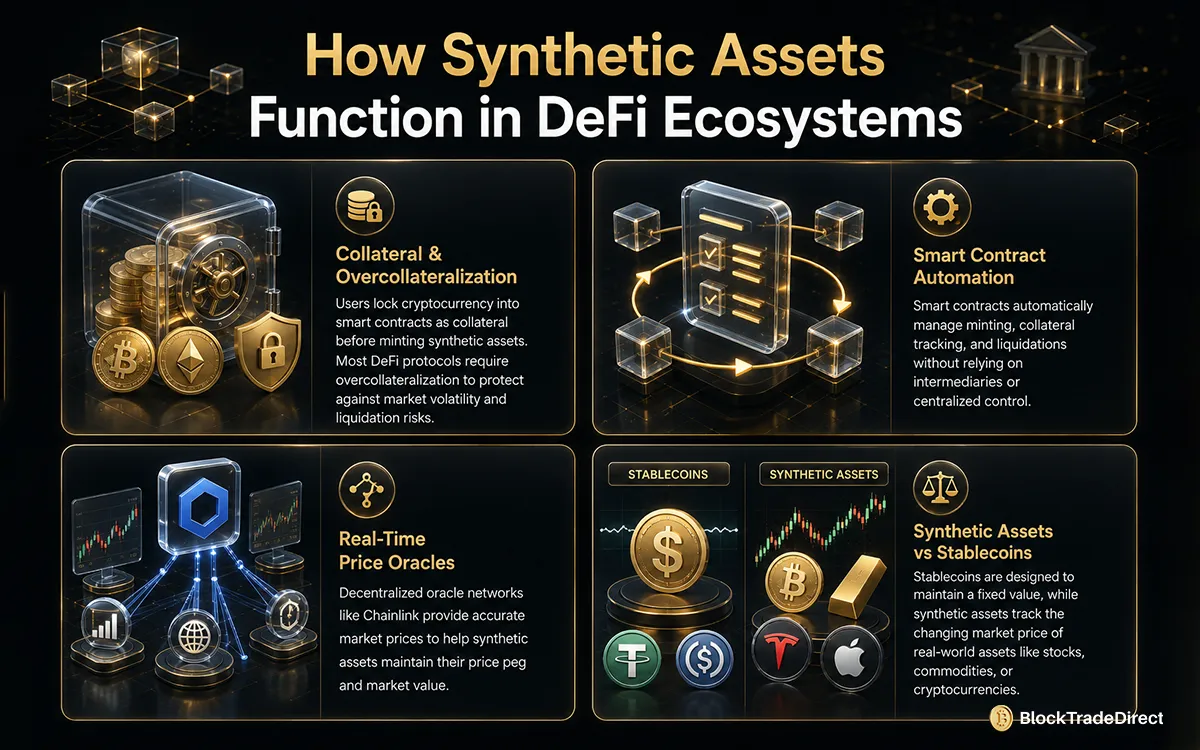
Now that you know what a synthetic asset is, it's worth understanding how one actually gets created and maintained on-chain. Three components work together to make the whole system function: collateral, smart contracts, and price oracles.
Every synthetic asset starts with collateral. To mint one, a user must first lock cryptocurrency into a smart contract as collateral. Because crypto prices are volatile, most protocols require overcollateralization — meaning you deposit more value than the synthetic asset is worth.
On Synthetix, one of the most established synthetic asset protocols on Ethereum, users stake SNX tokens to back the synths they mint. The protocol has historically required staked value to significantly exceed the value of synthetic assets minted, creating a buffer that protects the system if collateral prices drop. If your collateralization ratio falls too low and you don't top it up, the protocol can liquidate your position.
As of 2026, Synthetix holds approximately $42 million in total value locked, according to DefiLlama a reflection of how specialized and capital-intensive these protocols are compared to broader DeFi lending platforms.
The smart contract handles everything automatically: minting the synthetic token, tracking the collateral ratio, and triggering liquidations when thresholds are breached. No human intermediary is involved at any step.
But the smart contract needs to know what the real-world asset is actually worth at any given moment. That's where price oracles come in. Chainlink the most widely used decentralized oracle network in DeFi provides tamper-resistant, real-time price feeds from off-chain markets directly to the blockchain.
Synthetix itself relies on Chainlink price feeds to keep its synths accurately pegged. Without reliable oracle data, a synthetic asset cannot maintain its peg. If the price feed is corrupted or manipulated, the peg breaks — which is why oracle quality is one of the most critical factors in evaluating any synthetic asset protocol.
This is a point of genuine confusion for many new DeFi users, so it's worth taking a moment to clarify. A stablecoin is designed to maintain a fixed value, almost always pegged to the US dollar.
A synthetic asset, by contrast, is designed to track the live market price of something, which means it moves up and down constantly. Stablecoins in crypto serve as stable stores of value; synthetics serve as price exposure instruments. One is designed not to move. The other is designed to mirror something that does.
One of the most compelling things about synthetics is just how wide their scope is. Unlike most DeFi instruments that operate strictly within the crypto ecosystem, synthetics can mirror nearly any asset class in the world.
On the right protocol, you can get price exposure to:
As of early 2026, DeFi protocols collectively hold over $130 billion in total value locked across all categories, according to data cited by Dwellir's State of DeFi 2026 report. Synthetic asset protocols represent a specialized slice of that ecosystem, but one with unique strategic value, particularly for users in markets where traditional financial access is limited or restricted.
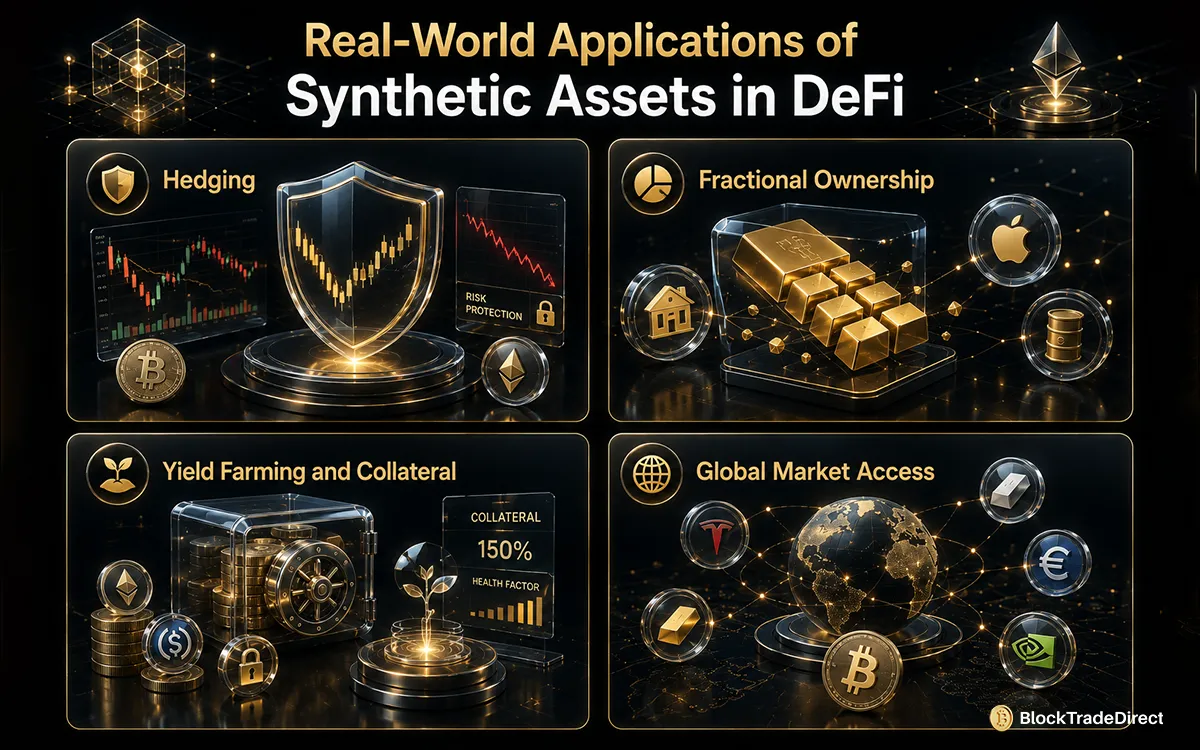
Understanding what synthetic assets are is one thing. Seeing how traders actually use them is what makes the value proposition click. Here are the four most common use cases in practice.
Risk management is one of the oldest reasons derivatives exist, and synthetic assets serve the same function in DeFi. Say you're holding a long position in Bitcoin and you're worried about the short-term downside. You could mint or buy an inverse BTC synthetic, a token that gains value when Bitcoin's price drops to offset some of that risk without closing your original position. This kind of on-chain hedging wasn't possible for most traders before DeFi.
Some assets are simply too expensive for most people to buy outright. Gold trades at a high price per ounce, and some stocks are out of reach for smaller investors.
Synthetic tokens representing these assets can be divided into fractions, letting anyone gain price exposure with far less capital. It opens up markets that have historically required either significant wealth or geographic proximity to the right exchanges.
On platforms like Synthetix, stakers who provide collateral to back synthetic assets earn protocol rewards in return. Those rewards can then be reinvested or used as collateral elsewhere in the DeFi ecosystem. Synthetic tokens themselves can also be used as collateral for borrowing other assets, creating composable yield strategies that chain multiple protocols together.
This is arguably the most meaningful use case of all. DeFi protocols don't check your passport or verify your net worth. Anyone with an internet connection and a crypto wallet can access markets that traditional finance has kept behind geographic or regulatory walls. For the majority of the world's population that lacks access to sophisticated financial markets, that's not a small thing.
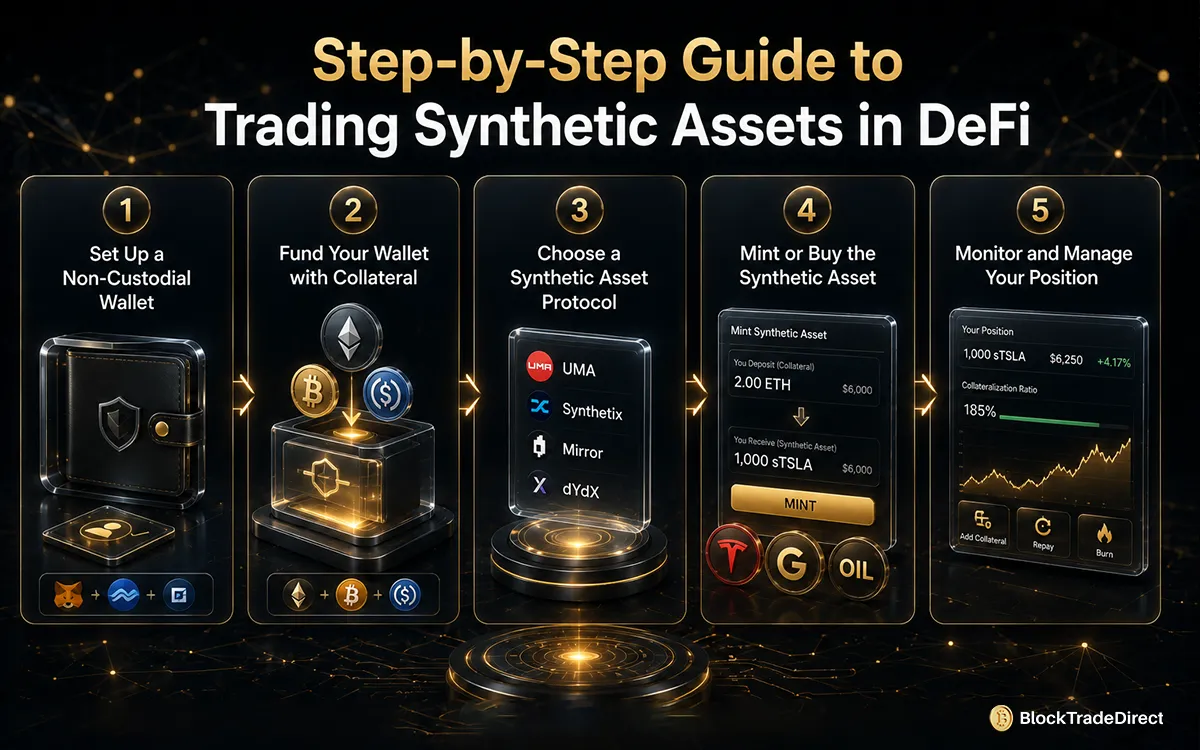
This is the section most guides skip. Understanding the theory is useful, but knowing the actual steps from wallet setup to live position is what most people actually need. Here's the full process, broken down clearly.
You'll need a wallet that connects to DeFi protocols. MetaMask is the most widely used option and works with most Ethereum-based synthetic asset platforms. Download it, create a wallet, and store your seed phrase somewhere secure and completely offline. Anyone with your seed phrase has full control of your funds.
Most synthetic asset platforms require a specific token as collateral. On Synthetix, that's SNX. You can purchase SNX on a centralized exchange like Binance, Coinbase, or OKX and transfer it to your MetaMask wallet, or buy it directly through a DEX. Make sure you also hold a small amount of ETH to cover gas fees on every transaction.
Synthetix is the most battle-tested option on Ethereum. It's been running since 2018 and has processed billions in synthetic asset volume. It allows users to mint synths across a wide range of asset classes using SNX as collateral. Other protocols exist across different chains, each with its own collateral requirements, fee structures, and available assets.
Before committing funds, check current TVL, audit history, and community activity on DefiLlama and the protocol's own governance forums. As of 2026, Synthetix's combined TVL sits at approximately $42 million, according to DefiLlama, operating primarily on the Ethereum mainnet.
You have two routes into a position. The first is minting: you lock your collateral in the protocol's smart contract, and the protocol mints a synthetic token representing your chosen asset. The second option is buying.
If someone else has already minted the synth, you can purchase it directly on Kwenta Synthetix's front-end trading interface or on another DEX without needing to provide collateral. Buying is simpler and poses lower risks for beginners. Minting gives you more control but comes with ongoing collateralization responsibilities.
If you are minted, your work doesn't stop at entry. You need to keep a close track of your collateralization ratio. If the value of your collateral drops or the synthetic asset's tracked price rises sharply your ratio can fall below the required threshold.
If that happens and you don't top up your collateral or burn some synths, the protocol can and will liquidate your position. Set price alerts. Check your ratio regularly. Know the liquidation threshold before you mint anything.
For broader guidance on managing positions in volatile crypto markets, BlockTrade Direct's trading and investment resources are worth reviewing before you start.
Knowing the advantages helps clarify why synthetic assets have earned a place in the DeFi toolkit despite their complexity. The core appeal comes down to four things.
First, they're permissionless; no broker, no KYC gate, and no geographic restriction stands between you and the market.
Second, you never take custody of the underlying asset, which removes storage costs, custody risks, and the logistical friction of holding physical gold or foreign stocks.
Third, they're composable; synths can plug into other DeFi protocols for lending, borrowing, or yield farming, making them far more flexible than traditional financial instruments.
Fourth, they offer genuinely global market access at a scale traditional finance has never matched, putting emerging market exposure and commodity trading in the hands of anyone with a smartphone.
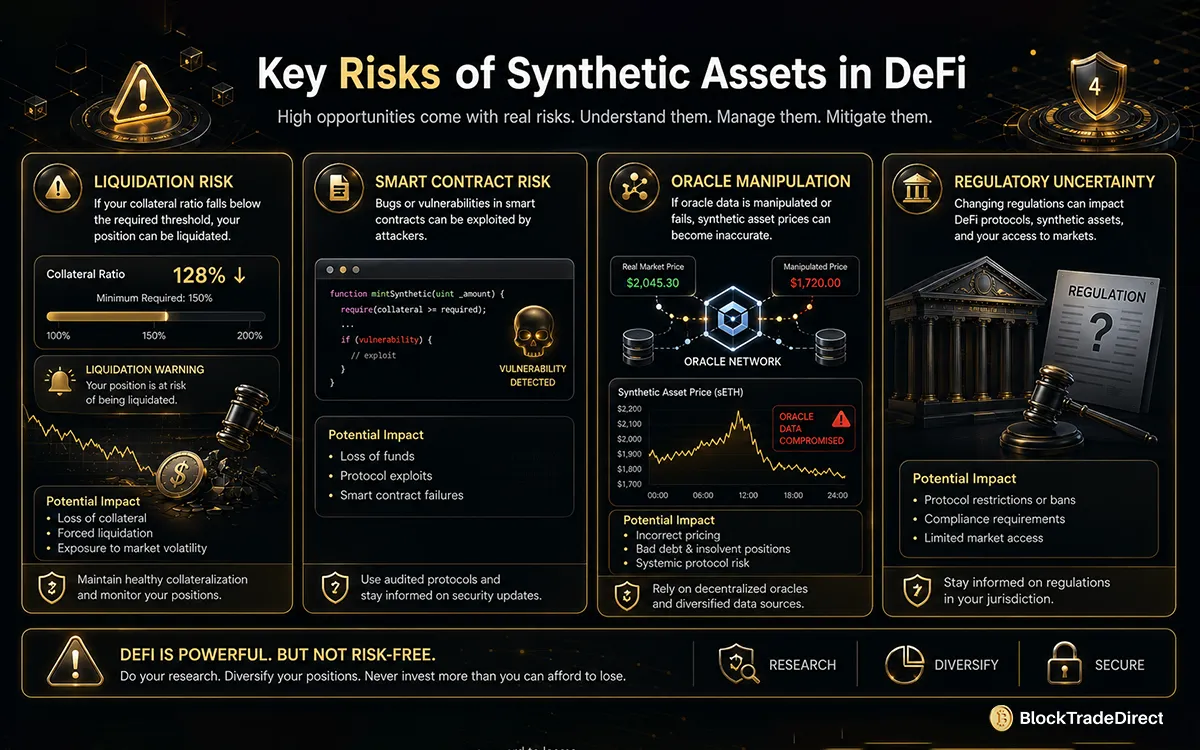
The benefits are real. So are the risks. Synthetic assets are among the more complex and high-risk instruments in DeFi, and anyone entering this space needs a clear-eyed understanding of what can go wrong before they commit funds.
If you're minting synths and your collateral value drops below the required ratio, the protocol liquidates your position automatically to protect the system. You can lose a significant portion of your collateral very quickly in volatile markets. This is not a theoretical risk — it happens regularly, especially during sharp market corrections when collateral prices fall faster than users can respond.
Every synthetic asset protocol runs on code. Code can have bugs. Even well-audited, long-standing protocols can be exploited. According to Chainalysis, DeFi protocols suffered $649 million in losses from smart contract exploits in 2025 alone. When a smart contract is compromised, funds locked inside it can be stolen or permanently lost. There is no deposit insurance and no central authority to appeal to.
Synthetic assets depend on price oracles to maintain their peg to real-world assets. If an attacker manages to manipulate the price feed — even briefly — they can drain protocol funds before the system corrects. Flash loan attacks that exploit oracle vulnerabilities have caused significant losses across DeFi, and this remains an active threat vector even for protocols using established oracle networks like Chainlink.
Synthetic assets that represent stocks, commodities, or foreign currencies may attract regulatory scrutiny depending on your jurisdiction. The legal status of these instruments is still evolving in most countries as of 2026, with regulators in multiple regions actively examining whether on-chain synthetic exposure to equities and commodities constitutes a regulated financial product.
Before entering any position, it's worth reading through common crypto trading mistakes to avoid many apply directly to synthetic asset trading.
Synthetic assets aren't a niche experiment anymore. They're one of the more sophisticated tools in DeFi sitting at the intersection of blockchain infrastructure, real-world market access, and programmable finance. The ability to gain price exposure to any asset in the world, without borders, brokers, or barriers, represents a genuine structural shift from how financial markets have always operated.
That said, the power comes with real complexity and real risk. The most effective traders in this space don't just chase yields they understand collateralization mechanics, monitor their positions actively, size their exposure carefully, and choose protocols with strong security track records.
If you're just getting started, take the time to understand how the infrastructure actually works before putting real money in. The upside of getting it right is significant. The cost of getting it wrong can be permanent.
Synthetic assets involve risks such as smart contract bugs, liquidations, and oracle failures. While established protocols like Synthetix are audited, no DeFi platform is completely risk-free. Always understand the risks and invest cautiously.
Both provide price exposure without owning the asset. The key difference is that derivatives use brokers and regulated exchanges, while synthetic assets run on decentralized smart contracts without intermediaries.
Yes. Anyone with a crypto wallet and internet access can trade synthetic assets. However, local regulations and platform restrictions may apply in some countries.
Synthetix is a DeFi protocol that lets users create synthetic assets called Synths by staking SNX tokens. These assets track real-world prices using decentralized oracles like Chainlink.