


A DAO (Decentralized Autonomous Organization) is a blockchain-based system where decisions are made collectively by members through token voting. Rules are enforced using smart contracts, removing the need for centralized leadership and enabling transparent, community-driven governance.
This idea sits right at the core of how the internet is evolving. In traditional systems, trust comes from institutions. In a DAO, trust comes from transparent code and shared incentives. That shift is a big part of what's driving the rise of Web3 - where users don't just participate, they have ownership and governance power.
In 2026, DAOs are no longer just experimental. They're being used to run DeFi protocols, fund projects, manage online communities, and even coordinate global investments. You'll see them across crypto ecosystems, quietly replacing structures that used to rely on centralized control.
If you're new to this space, it helps to first understand the bigger picture of how decentralized systems are reshaping finance and ownership. This breakdown of how blockchain is changing finance industries gives useful context before diving deeper into DAOs.
Before getting into how DAOs function, it helps to break down the term itself. The acronym is simple, but each part points to a core idea - how control is distributed, how decisions are made, and how these organizations operate without traditional leadership.
At its simplest, DAO = Decentralized Autonomous Organization.
In crypto, a DAO is essentially a community-run system where decisions happen through voting, and outcomes are executed via Smart Contracts on a blockchain.
The term "DAO" isn't exclusive to crypto, which is where some confusion comes in.
But in crypto, the meaning is specific - it's about on-chain governance, not just structure.
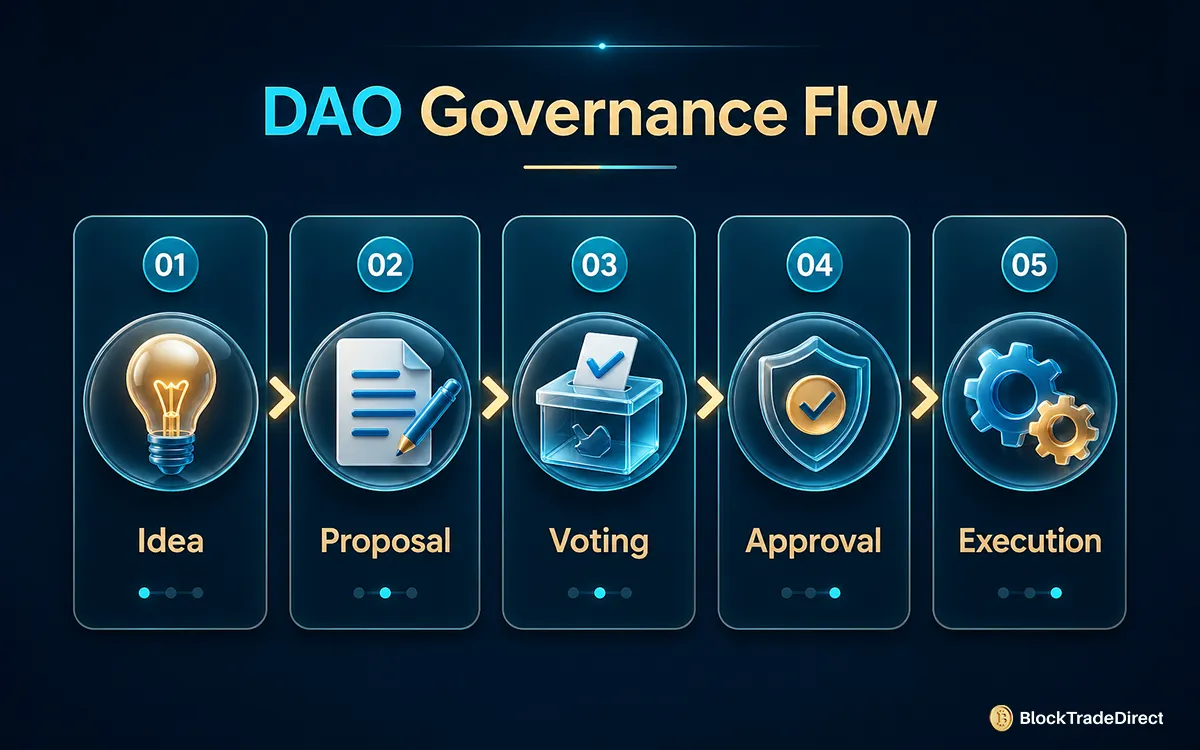
Once you understand what a DAO is, the next step is seeing how it actually operates. At its core, a DAO runs on a mix of code, tokens, and community decisions - working together to replace traditional management with a structured, transparent process.
At the core of every DAO are Smart Contracts.
These are self-executing pieces of code that define the rules - how voting works, how funds are managed, what conditions trigger actions.
Once deployed, these rules aren't easily changed. That's the point. No one can quietly override decisions or bend the system behind the scenes.
Most DAOs run on governance tokens. If you hold the token, you get a say.
This shifts control from a central authority to a distributed group of participants.
A typical DAO decision follows a simple loop:
No manual approvals. No intermediaries.
If you zoom out, this entire process is built on blockchain infrastructure. If you need a refresher on how that foundation works.
Once you understand this flow, the rest of the DAO concepts start to feel much more intuitive.
At a glance, DAOs look like online communities. Under the hood, they operate very differently.
No central authority. Decisions aren't made by a CEO or board - they're distributed across members.
Every proposal, vote, and transaction is recorded on-chain. Anyone can verify what's happening.
Ownership and governance are tied to tokens. If you're involved, you have a measurable stake.
Once conditions are met, outcomes are executed through Smart Contracts and no manual intervention needed.
Anyone with an internet connection and a crypto wallet can participate. Geography doesn't matter.
Put together, these features create a system that's more open, but also more dependent on code and community behavior than traditional setups.
DAOs can feel abstract until you see how they actually operate. Looking at real examples makes it easier to understand how decentralized governance works in practice - and what these organizations are capable of managing today.
MakerDAO is one of the earliest and most established DAOs. It governs the DAI stablecoin. Token holders vote on things like collateral rules, interest rates, and system upgrades. These decisions directly affect how the entire ecosystem functions.
Uniswap uses a DAO model to manage one of the largest decentralized exchanges. Governance token holders propose and vote on fee structures, treasury usage, and protocol changes. It's a clear example of a DAO running critical financial infrastructure.
ConstitutionDAO was created to collectively bid on a rare copy of the U.S. Constitution. It raised tens of millions in a matter of days. While the bid didn't succeed, it showed how quickly a DAO can coordinate capital and community at scale.
These examples highlight something important - DAOs aren't one-size-fits-all. They can run financial systems, govern protocols, or bring people together around a shared goal.
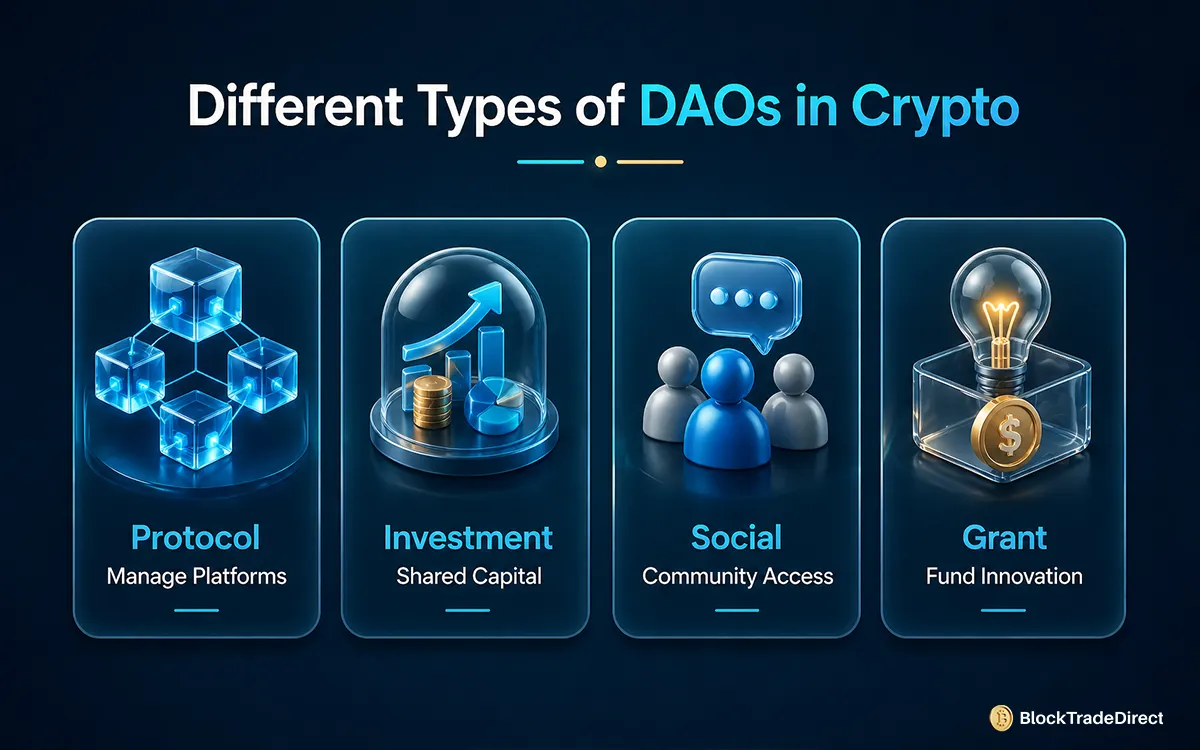
Not every DAO is built for the same purpose. Some focus on finance, others on communities or funding projects. Breaking them into categories helps clarify how flexible this model really is.
These govern blockchain protocols and DeFi platforms. Decisions typically involve upgrades, fees, and risk parameters.
Groups that pool capital and decide collectively where to invest. Think of it as a crypto-native venture fund, but with shared control.
Focused on community, memberships, or creative collaboration. Members might get access to exclusive content, events, or networks.
Designed to fund builders and projects within a blockchain ecosystem. They allocate treasury funds to developers, startups, or research initiatives.
Once you see these categories, it becomes clear that a DAO isn't a single model - it's a flexible structure that can be adapted to very different goals.
DAOs aren't just a technical experiment - they solve a few real problems that traditional structures struggle with.
Anyone holding governance tokens can vote. Power isn't limited to a small leadership group.
People from anywhere can contribute, invest, or vote without needing permission or intermediaries.
Processes are handled by Smart Contracts, cutting out layers of approval and oversight.
Every action - votes, treasury movements, proposals - is visible on-chain.
Participants often have skin in the game through tokens, which encourages long-term thinking.
That said, these benefits only hold if the system is designed well. Poor governance or low participation can quickly weaken even the most promising DAO.
DAOs offer a new way to organize, but they're far from perfect. Alongside the benefits, there are real risks - technical, governance-related, and regulatory - that anyone exploring this space should understand.
DAOs rely heavily on code. If there's a flaw, it can be exploited. The most well-known case is The DAO Hack, where a vulnerability led to millions in losses. Once deployed, fixing issues isn't always straightforward.
In theory, everyone has a voice. In practice, participation can be low.
This can skew outcomes and reduce true decentralization.
Laws around DAOs are still evolving. Some jurisdictions are starting to recognize them legally, while others treat them as unregulated entities.
Add updated regulatory developments or country-specific frameworks here (2026 data placeholder).
Without central leadership, decision-making can slow down. Reaching consensus across a global, distributed group isn't always efficient.
DAOs open up new possibilities - but they also introduce a different kind of risk. One that comes from code, incentives, and human behavior all interacting at once.
Behind every DAO is a stack of tools that handle voting, treasury management, and coordination.
Tools like Snapshot let members vote on proposals without paying high transaction fees. It's widely used for off-chain governance.
Platforms such as Aragon help launch and manage DAOs without needing to build everything from scratch.
Multi-signature wallets and on-chain systems are used to manage funds securely and transparently.
Most DAOs coordinate through Discord, forums, and governance dashboards rather than traditional corporate tools.
If you're exploring DAOs beyond theory, this is where things start to feel real - tools, workflows, and actual participation.
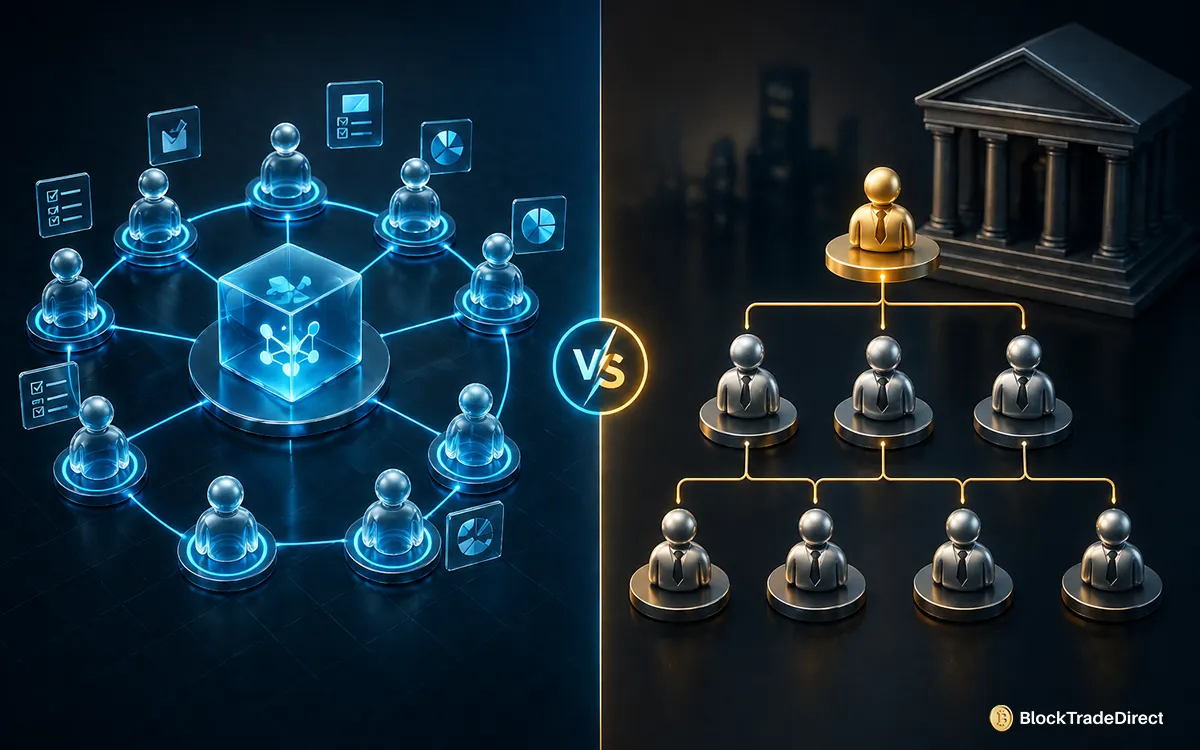
At a high level, DAOs flip how organizations are usually run. Instead of centralized control, they rely on distributed decision-making and code.
Key differences explained:
Traditional organizations rely on executives or boards. DAOs distribute control across token holders.
Company decisions are often internal. DAOs operate on public blockchains where actions are visible.
In a DAO, proposals are voted on by the community instead of approved by leadership.
Traditional systems can act quickly. DAOs may move slower due to voting cycles and consensus.
Organizations depend on people and institutions. DAOs rely on Smart Contracts and transparent rules.
This isn't about one being strictly better - it's about different trade-offs depending on the use case.
Getting involved in a DAO is more accessible than it sounds. You don't need to be a developer - you just need to understand how the ecosystem works.
Most DAOs require tokens to vote or submit proposals.
Discussions usually happen on forums, Discord, or governance portals.
Even small participation matters. Voting is how decisions are made.
Many DAOs reward contributors - developers, writers, marketers, and researchers.
If you're starting from scratch, the first step is setting up access to crypto markets, opening a trading account, and getting tools. This guide can help you get started.
Once you're in, participation is less about permission - and more about showing up and contributing.
DAOs are still evolving, but a few trends are becoming hard to ignore.
DAOs are moving into gaming, creator economies, and even real-world asset management.
New voting systems and incentive structures are being tested to reduce whale dominance and improve participation.
Traditional companies and funds are exploring DAO-like structures for coordination and capital allocation.
As ecosystems connect, DAOs are starting to operate across multiple blockchains rather than staying siloed. This shift ties closely to how cross-chain technology systems are developing.
The direction is clear - DAOs aren't replacing everything overnight, but they're steadily reshaping how people organize and collaborate online.
A DAO is essentially a new way to run organizations - one where code replaces intermediaries and communities replace centralized control. It's not perfect, and it comes with trade-offs, but it opens up a model that's more transparent, global, and participatory than what most systems offer today.
If you're exploring crypto seriously, understanding DAOs isn't optional anymore. They're becoming a core layer of how decisions, capital, and communities are managed in Web3.
A DAO (Decentralized Autonomous Organization) is a blockchain-based organization where decisions are made by members through token voting. Instead of a central authority, rules are enforced using Smart Contracts, making governance transparent and automated.
A DAO works through a simple process: members submit proposals, token holders vote on them, and approved decisions are executed automatically via smart contracts. This removes intermediaries and ensures outcomes follow predefined rules.
Popular DAO examples include MakerDAO, which governs a stablecoin system, and Uniswap, where token holders vote on protocol changes. These show how DAOs manage real financial platforms.
DAOs offer transparent decision-making, global participation, reduced reliance on intermediaries, and community-driven governance. Members have direct influence through voting, which creates a more democratic structure compared to traditional organizations.
DAOs can face smart contract vulnerabilities, low voter participation, and regulatory uncertainty. A well-known example is The DAO Hack, which exposed security risks in early DAO structures.
You can join a DAO by purchasing its governance token, joining its community channels, and participating in voting or discussions. Some DAOs also reward contributors for active involvement.
The legal status of DAOs varies by country. Some regions are beginning to recognize them as legal entities, while others still lack clear regulations. Always check local laws before participating.
A DAO is decentralized and governed by token holders, while traditional organizations rely on centralized leadership. DAOs use smart contracts for execution, whereas traditional systems depend on human decision-making and internal processes.
Common DAO tools include Snapshot for voting and Aragon for creating and managing DAOs. These tools handle governance, treasury, and coordination.
DAOs enable decentralized governance, which is a core principle of Web3. They allow users to own, manage, and shape platforms instead of relying on centralized companies.