


Cryptocurrency has a reputation problem, and it largely comes down to energy.
For years, networks like Bitcoin have been criticized for their massive electricity consumption. Recent estimates suggest Bitcoin alone uses around 100–200 terawatt-hours (TWh) per year, putting it on par with the energy usage of entire countries. That level of demand raises real concerns about carbon emissions, environmental impact, and long-term sustainability.
At the same time, crypto adoption hasn’t slowed down. It continues to expand across finance, gaming, and global payments. This creates a clear tension. The world wants blockchain innovation, but not at the cost of the planet.
This is where green cryptocurrencies, also known as eco-friendly or energy-efficient cryptocurrencies, come in.
Green cryptocurrencies are digital currencies designed to reduce environmental impact by using energy-efficient systems like Proof of Stake instead of energy-intensive validation processes.
The shift is already happening. Ethereum, for example, reduced its energy consumption by over 99.9% after moving away from energy-intensive validation systems, making it one of the most significant sustainability upgrades in crypto history.
In simple terms, crypto is evolving, and sustainability is becoming a core part of that evolution.
In this guide, we’ll break down what green cryptocurrencies are, how they work, and why they’re quickly becoming one of the most important trends in the crypto space heading into 2026.
Green cryptocurrencies are digital currencies designed to reduce environmental impact without sacrificing the core benefits of blockchain technology. Instead of relying on energy-heavy validation systems, they use more efficient methods to validate transactions and secure the network.
At a basic level, the difference comes down to how transactions are verified.
Traditional cryptocurrencies like Bitcoin depend on Proof of Work (PoW), where powerful computers compete to solve complex puzzles. This process consumes massive amounts of electricity and scales poorly as demand increases.
Green cryptocurrencies take a different approach. They use mechanisms like Proof of Stake (PoS) and other lightweight systems that don’t require energy-intensive validation processes.
If you’re new to how crypto works overall, it helps to understand the broader ecosystem and types of cryptocurrency.
Validators are selected based on stake, not computing power
No need for large-scale validation infrastructure
More efficient systems reduce processing time
Networks can grow without increasing energy demand
|
Feature |
Traditional Crypto (PoW) |
Green Crypto |
|
Energy Usage |
Extremely high |
Low to minimal |
|
Validation Method |
Computational validation (Proof of Work) |
Staking / efficient consensus |
|
Hardware Requirement |
High-performance computational hardware |
Basic nodes or validators |
|
Transaction Speed |
Slower |
Faster |
|
Environmental Impact |
High carbon footprint |
Reduced or near-zero |
Green cryptocurrencies aren’t just a niche idea anymore. They represent a broader shift in how blockchain networks are being designed.
Instead of optimizing only for security and decentralization, modern networks are now balancing efficiency, scalability, and sustainability from the ground up.

The environmental debate around crypto didn’t come out of nowhere. It grew as networks like Bitcoin scaled and their energy demand became impossible to ignore.
Bitcoin’s Proof of Work system relies on millions of machines running continuously to validate transactions. As competition increased, so did the computing power required. The result is a system that now consumes roughly 100–200 TWh of electricity annually. A significant portion of traditional validation systems still relies on fossil fuels.
To put that into perspective, that’s comparable to the energy usage of countries like Argentina or the Netherlands.
Even more striking, a single Bitcoin transaction can consume as much energy as thousands of Visa transactions, highlighting how inefficient the system can be at scale.
This rapid growth is closely tied to how blockchain is revolutionizing the finance industry, as its adoption continues to expand across multiple sectors.
A significant portion of traditional validation systems still relies on fossil fuels
Massive power usage for relatively low transaction throughput
Specialized hardware used in these systems becomes obsolete quickly
Large-scale validation operations can strain local energy infrastructure
This issue has moved beyond environmental discussions and into mainstream policy and investment decisions.
At the same time, users are becoming more conscious of the environmental cost behind digital assets.
This growing pressure is exactly what’s driving the rise of green cryptocurrencies.
They offer a way to keep the benefits of blockchain, like decentralization and transparency, while addressing one of its biggest limitations: energy consumption.
Not every low-energy crypto automatically qualifies as “green.” The difference comes down to how the network is designed and whether efficiency is built into the system itself.
At its core, a green cryptocurrency reduces energy use at the protocol level, not just by offsetting emissions after the fact.
Systems like Proof of Stake replace energy-intensive validation processes with more efficient alternatives, cutting energy use dramatically
No need for high-powered hardware running continuously
Faster systems that process more transactions with less energy
Validators may rely on solar, wind, or hydro-powered infrastructure
Some projects offset or even exceed their emissions through sustainability initiatives
Validators are selected based on how much crypto they hold and lock in the network
A time-based system that improves efficiency and reduces validation load
Removes the need for traditional block-based validation systems entirely
|
Factor |
Why It Matters |
|
Low energy validation |
Reduces electricity consumption |
|
Lightweight infrastructure |
Cuts hardware and operational costs |
|
High transaction efficiency |
More output with less energy input |
|
Carbon neutrality |
Aligns with global sustainability goals |
Not all “green” claims are equal.
Some projects focus heavily on sustainability messaging without providing transparent or verifiable data. Others rely only on carbon offsets instead of actually reducing energy consumption at the network level.
The most credible green cryptocurrencies are the ones that build efficiency directly into how the system works, not just how it’s marketed.
This is why understanding the underlying technology matters just as much as the label.
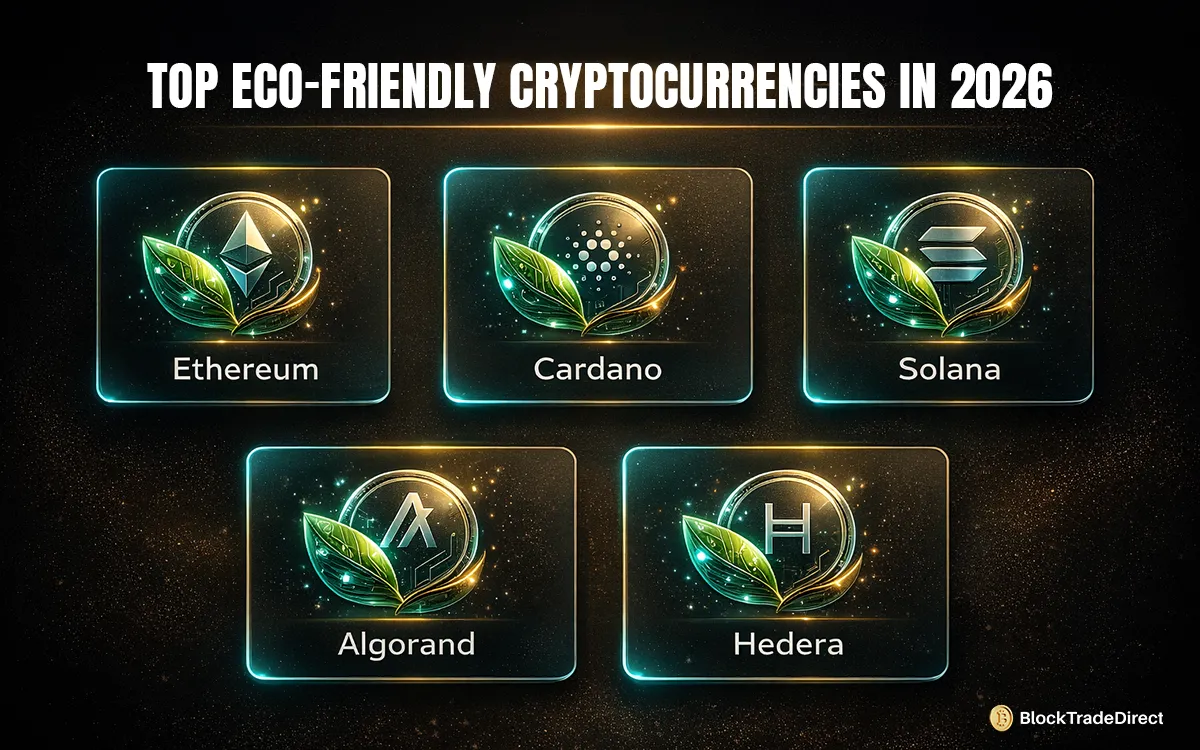
Green crypto isn’t theoretical anymore. Several major projects have already proven that blockchain can run efficiently without massive energy consumption.
Here are some of the most relevant green cryptocurrencies shaping the space in 2026:
Real-world use: Backbone of decentralized finance applications and NFT marketplaces
Real-world use: Used in identity systems, education projects, and government pilots
Real-world use: Popular in gaming, NFTs, and high-speed trading platforms
Real-world use: Used in financial infrastructure and tokenization projects
Real-world use: Enterprise applications, supply chain tracking, and digital identity
Many of these fall under the broader category of altcoins, which offer alternatives to Bitcoin with different technologies.
|
Crypto |
Mechanism |
Energy Efficiency |
Unique Edge |
|
Ethereum |
PoS |
Very high |
Largest ecosystem |
|
Cardano |
PoS |
High |
Research-driven |
|
Solana |
PoH + PoS |
Very high |
Speed and scalability |
|
Algorand |
Pure PoS |
High |
Carbon-negative network |
|
Hedera |
DAG / Hashgraph |
Extremely high |
Enterprise adoption |
The shift toward sustainability isn’t limited to smaller projects. Even major networks are redesigning themselves around efficiency.
Energy consumption is now a competitive advantage. Projects that combine speed, scalability, and sustainability are attracting users, developers, and institutional capital.
Green cryptocurrencies aren’t just better for the environment. They also make blockchain more practical and scalable.
Reduced energy consumption leads to fewer carbon emissions
Efficient systems process transactions more quickly than traditional energy-intensive validation systems
Networks can grow without requiring massive increases in energy usage
More likely to meet evolving government and ESG standards
Lower fees and easier participation without expensive hardware
Green cryptocurrencies solve a major problem, but they come with trade-offs.
Proof of Stake systems can concentrate power among large token holders
Some argue Proof of Work remains more battle-tested and resistant to attacks
Not all projects provide transparent or verifiable data to support sustainability claims
If you’re planning to invest or build in this space, it’s important to look beyond the “green” label. Not all projects deliver on their sustainability claims.
Prefer Proof of Stake or other low-energy models over Proof of Work
Transparent reporting matters more than marketing claims
Strong ecosystems usually signal long-term viability
Make sure control isn’t concentrated among a few participants
Active development indicates a healthy and evolving network
Sustainability is important, but it shouldn’t be the only factor.
A strong green cryptocurrency should balance:
To make better decisions, it helps to follow proven strategies and avoid common crypto trading mistakes.
Green cryptocurrencies are part of a much larger ecosystem. Understanding how different types of cryptocurrencies work can give you a clearer investment perspective.

Cryptocurrency is at a turning point.
The early focus was on decentralization and innovation. Now, sustainability is becoming just as important. Green cryptocurrencies are leading that shift by proving that blockchain doesn’t have to come with massive environmental costs.
Regulation is starting to favor energy-efficient networks, while institutional investors are increasingly backing projects that align with ESG standards. This shift is pushing sustainability from a niche advantage to a core requirement.
As the industry matures, energy efficiency is no longer a differentiator. It’s becoming the default.
For users, investors, and developers, that changes how decisions are made. Projects are now judged not just on performance or returns but on how responsibly they operate at scale.
If you’re planning to actively participate in this space, whether through trading or long-term investing, trading and investment options on BlockTradeDirect..
The projects that win won’t just be fast or profitable. They’ll be the ones that can scale without costing the planet.
Green cryptocurrencies are eco-friendly digital assets that use energy-efficient systems like Proof of Stake instead of energy-intensive validation processes. They reduce electricity consumption while maintaining blockchain security and functionality.
Green cryptocurrencies are important because traditional crypto consumes large amounts of energy, contributing to carbon emissions. They offer a more sustainable way to use blockchain technology without harming the environment.
They rely on validation systems that don’t require high-powered computational processes. For example, Proof of Stake selects validators based on holdings rather than computational work, reducing energy usage by over 99% in some networks.
Proof of Work relies on energy-intensive validation processes, while Proof of Stake uses validators who lock up tokens. PoS is significantly more energy-efficient, faster, and widely used in modern green cryptocurrencies.
No, they are not completely impact-free. They still rely on infrastructure like servers and internet networks, but their environmental footprint is significantly lower than that of traditional cryptocurrencies.
Some of the leading green cryptocurrencies include Ethereum, Cardano, Solana, Algorand, and Hedera. These networks are known for their low energy consumption and efficient design.
It depends on your goals, but many investors consider them strong long-term options due to ESG trends, regulatory support, and growing adoption of sustainable blockchain technology.
They may not fully replace Bitcoin, but they are increasingly becoming the preferred choice for new projects and investors. Over time, energy-efficient systems are likely to dominate the crypto ecosystem.