


Smart contracts are one of the core ideas behind how crypto actually works beyond just buying and selling tokens. They allow agreements to run automatically on a blockchain without needing a middleman, paperwork, or manual approval.
At a basic level, a smart contract is just code. But instead of sitting on a private server, it lives on a blockchain and executes exactly as programmed. Once the conditions are met, the outcome happens instantly. No delays, no back-and-forth, and no reliance on a third party.
This is what makes them so important. Smart contracts are the engine behind things like decentralized finance, NFTs, and blockchain-based apps. If you’ve interacted with crypto beyond simple trading, chances are you’ve already used one without even realizing it.
A smart contract is a self-executing program stored on a blockchain that runs when specific conditions are met. Instead of relying on people or institutions to enforce an agreement, the code handles everything automatically.
A simple way to think about it is like a vending machine. You insert money, select a product, and the machine delivers it instantly. There’s no shopkeeper involved. Smart contracts follow the same logic. If the predefined conditions are true, the outcome is executed.
For example, imagine sending crypto to someone only after they complete a task. A smart contract can be set up so that once the condition is verified, the payment is released automatically. No follow-ups, no trust issues.
Because these contracts run on a blockchain, they are transparent, tamper-resistant, and cannot be changed once deployed.
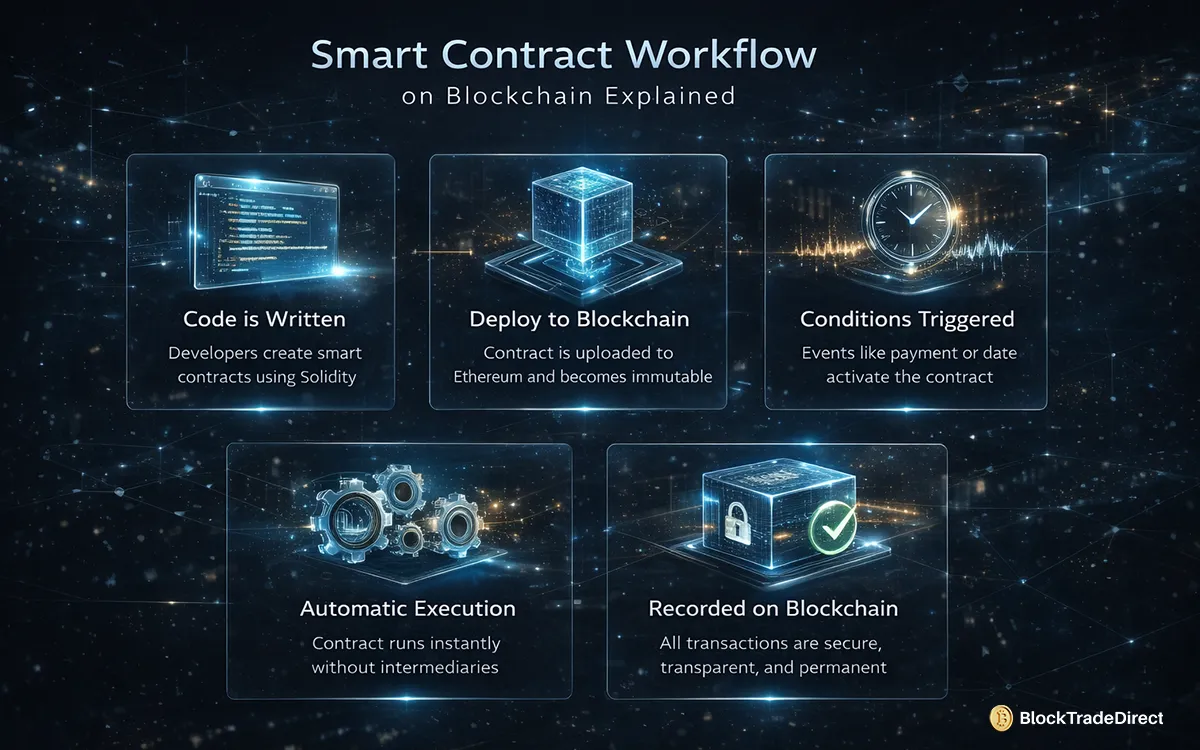
Smart contracts follow a simple logic, but the way they execute on a blockchain is what makes them powerful. Here’s how the process typically works from start to finish.
A developer writes the smart contract using a programming language designed for blockchain, such as Solidity. This code defines the rules and conditions. Once ready, it’s deployed to a blockchain network like Ethereum, where it becomes publicly accessible and immutable.
The contract stays idle until its conditions are met. These conditions could be anything, like receiving a payment, reaching a specific date, or verifying an external event through a data source.
As soon as the conditions are satisfied, the contract executes on its own. There’s no need for approval or manual processing. The action could be transferring funds, granting access, or recording ownership.
Every action is recorded on the blockchain. This makes the transaction transparent, traceable, and permanent. For example, if you send crypto through a smart contract, it will only release the funds when the agreed condition is fulfilled.
Smart contracts are what turn blockchain from a simple record-keeping system into something far more useful. Without them, crypto would mostly be limited to sending and receiving tokens. With them, you can build entire financial systems, apps, and digital economies that run on code.
The key shift is trust. Instead of relying on banks, brokers, or platforms to enforce agreements, smart contracts handle it automatically. This reduces delays, cuts costs, and removes a lot of the friction that comes with traditional systems.
They’re also a big reason why blockchain is reshaping industries beyond crypto. From finance to supply chains, automation and transparency are changing how transactions happen at a fundamental level. To understand the bigger picture, see how blockchain is transforming finance.
In short, smart contracts are the backbone of everything that makes crypto functional and scalable.
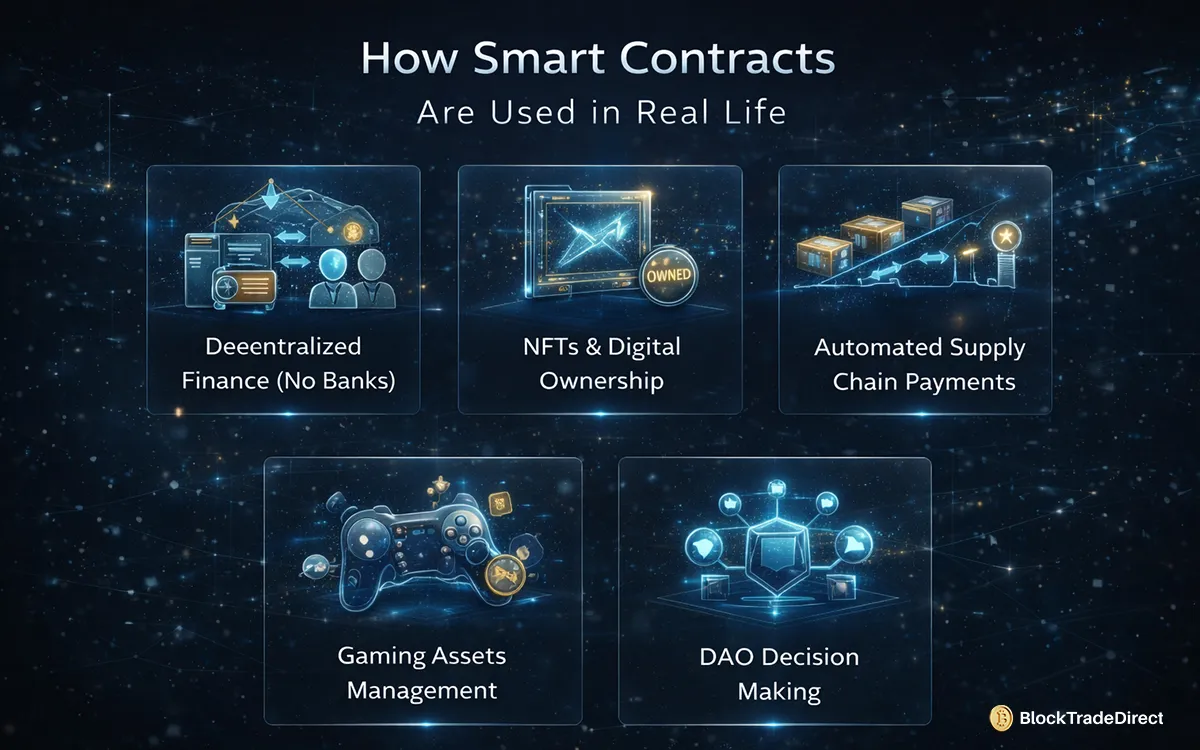
Smart contracts aren’t just a concept. They’re already being used across different parts of the crypto ecosystem and beyond. Here’s where they show up in practical ways.
Smart contracts power lending, borrowing, and staking platforms. Instead of going through a bank, users interact directly with code that manages funds and executes transactions automatically through decentralized applications shaping the future of finance.
Smart contracts define ownership and control how digital assets are transferred. They also enable creators to earn royalties automatically every time an NFT is resold.
In supply chains, smart contracts can release payments only when goods are delivered and verified. This reduces disputes and improves transparency across multiple parties.
In blockchain games, smart contracts manage in-game assets and rules. In DAOs, they handle voting and decision-making, ensuring outcomes are executed exactly as agreed.
Across all these use cases, the common thread is simple: less reliance on intermediaries, more automation.
Smart contracts solve some of the biggest inefficiencies in traditional systems. Their value comes from how they simplify and automate processes that usually require multiple parties.
One of the biggest advantages is the removal of intermediaries. There’s no need for banks, brokers, or legal middlemen to enforce agreements. This not only speeds things up but also reduces costs.
Execution is instant. Once conditions are met, the contract runs automatically without delays or manual approval. This makes transactions faster and more predictable.
They’re also transparent. Since smart contracts live on a blockchain, anyone can verify how they work and track transactions. This builds trust without relying on a central authority.
Finally, they reduce human error. Because everything is predefined in code, there’s less room for miscommunication or manipulation. Together, these benefits are what make smart contracts such a powerful part of the crypto ecosystem.
Smart contracts are powerful, but they’re not perfect. Understanding their limitations is just as important as knowing their benefits.
One of the biggest risks is code vulnerability. If there’s a bug or flaw in the contract, it can be exploited. And because smart contracts are usually immutable, fixing those issues after deployment is difficult. This is why audits are critical.
Another challenge is irreversibility. Once a smart contract executes, the transaction cannot be undone. If something goes wrong, there’s often no easy way to reverse it.
There’s also a legal gray area. In many regions, smart contracts don’t yet have clear legal recognition, which can create uncertainty in disputes.
Finally, smart contracts often rely on external data sources, known as oracles. If the data fed into the contract is incorrect or manipulated, the outcome will still execute as programmed.
Smart contract risks are very real. In 2025, crypto hacks caused around $2.87 billion in losses, with a large share linked to DeFi and contract vulnerabilities.
Roughly two-thirds of DeFi losses came from smart contract flaws, often due to weak testing or missed bugs. Even small errors can be costly. In one case, a single exploit led to over $100 million in losses.
Early 2026 trends show the risk hasn’t slowed, with tens of millions still being lost each month. At the same time, the industry is improving. More projects now invest in audits, bug bounties, and stronger security practices, though risks remain a key concern.
These risks don’t make smart contracts unreliable, but they do highlight the need for careful design and usage.
Smart contracts and traditional contracts serve the same purpose, but they work in very different ways. One relies on code and automation, the other on legal systems and manual enforcement.
A quick comparison makes the difference clear:
|
Feature |
Smart Contracts |
Traditional Contracts |
|
Speed |
Instant execution |
Slower, depends on processing |
|
Cost |
Lower (no intermediaries) |
Higher (legal, admin fees) |
|
Enforcement |
Automatic via code |
Requires legal action |
|
Transparency |
Public and verifiable |
Private and restricted |
|
Flexibility |
Hard to change once deployed |
Easier to modify |
The key trade-off comes down to control versus efficiency. Smart contracts are faster and more efficient, but less flexible once live. Traditional contracts offer more adaptability, but rely heavily on trust and enforcement systems.
Both still have their place depending on the situation.
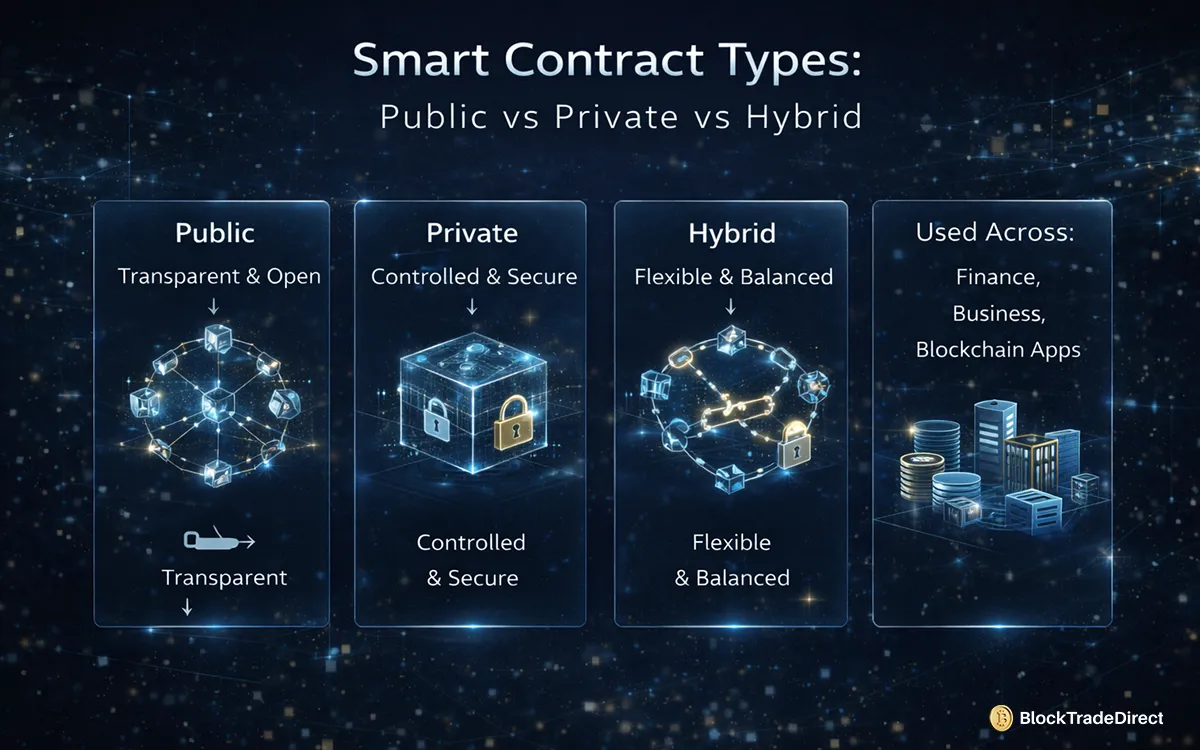
Not all smart contracts work the same way. They vary based on where they’re deployed and how they’re used.
Public blockchain contracts are the most common. These run on open networks like Ethereum, where anyone can interact with them. They power most DeFi apps, NFTs, and decentralized platforms.
Businesses use private or permissioned contracts. Access is restricted, and they’re often designed for internal processes like supply chain tracking or enterprise automation.
Hybrid contracts combine both. They use public blockchains for transparency while keeping certain data or operations private. Different types of smart contracts exist because different use cases need different levels of access, control, and transparency which is why understanding how to evaluate blockchain systems using different types of cryptocurrency analysis becomes essential.
Smart contracts are moving beyond basic transactions and becoming part of larger, more complex systems.
One major shift is integration with AI and automation. Contracts are starting to respond to real-time data and make more dynamic decisions, especially in finance and logistics.
Cross-chain compatibility is also improving. Instead of being limited to one blockchain, smart contracts are beginning to work across multiple networks, making the ecosystem more connected.
Another growing area is real-world asset tokenization. Things like real estate, stocks, and even legal agreements are being linked to smart contracts, bridging the gap between digital and physical assets.
Smart contract adoption is accelerating fast across both crypto and traditional industries.
The global smart contracts market is projected to reach around $3.3–$3.4 billion in 2026, with long-term growth expected at over 20%+ CAGR as adoption expands across finance, supply chains, and enterprise systems.
Adoption is no longer niche. Over 60% of medium and large enterprises are already using smart contracts in some capacity, a sharp rise from under 15% just a few years ago.
In crypto, growth is driven by DeFi. The DeFi market is expected to reach $37+ billion in 2026, growing at a massive 68% CAGR, with smart contracts at the core of every protocol.
Institutional adoption is also accelerating. Around 85% of financial institutions are exploring or implementing smart contracts, signaling a shift toward mainstream use.
Overall, smart contracts are moving from experimental tech to core infrastructure across both crypto and traditional finance.
Getting started with smart contracts doesn’t mean you need to start coding right away. The first step is understanding how they fit into the broader crypto ecosystem.
Start by learning the basics of blockchain and how transactions work. This gives you the foundation to understand what smart contracts are actually doing behind the scenes.
Next, explore real platforms. Try using DeFi apps, NFT marketplaces, or other blockchain-based tools where smart contracts are actively used. This hands-on experience makes things click faster than theory alone.
If you want to go further, you can explore crypto trading and investment options here or start with a basic account setup.
Smart contracts are a big reason why crypto is more than just digital money. They bring automation, transparency, and efficiency into systems that have traditionally relied on trust and intermediaries.
At the same time, they’re not without risks. Bugs, security gaps, and legal uncertainty still exist, which makes understanding how they work just as important as using them.
As adoption grows, smart contracts are likely to become a core part of how digital transactions and agreements are handled across industries.
If you’re exploring crypto seriously, understanding smart contracts isn’t optional. It’s foundational.
A smart contract is a program stored on a blockchain that automatically runs when certain conditions are met. It removes the need for intermediaries by executing agreements through code.
In some regions, they can be recognized as legally binding, but regulations are still evolving. In most cases, they function as technical agreements rather than traditional legal contracts.
Ethereum is the most widely used, but other blockchains like BNB Chain, Solana, and Polygon also support smart contracts.
Usually no. Once deployed, they are immutable. Some projects use upgradeable contracts, but that introduces additional complexity and risks.
They are secure when properly written and audited, but vulnerabilities can still exist. Bugs or poor design can lead to exploits.
A simple example is a payment contract that releases funds automatically once a condition is met, such as delivery confirmation or task completion.