

The CLARITY Act is a US bill. It would settle one of crypto's oldest fights: is your token a security or a commodity? Securities fall under the SEC. Commodities fall under the CFTC. The bill sorts digital assets into clear groups. It sets rules for how a token can move between them. It gives traders and exchanges one law to point to, instead of years of lawsuits.
As of mid-July 2026, the bill has passed the House. It has cleared a Senate committee, according to the official Congress.gov bill tracker. It now sits on the Senate calendar, waiting on a floor vote that hasn't happened yet. Here's what the bill does, and where it stands right now.
Legislative status changes fast. This reflects reporting as of the date above - check the timeline section below before you assume anything's final.
Here's the problem the CLARITY Act is trying to fix. No federal law has ever defined what a "digital asset" is. Not one. So for almost ten years, two regulators have fought over the same market. Each one used a different rulebook.
The SEC leaned on the Howey Test. It's a legal standard from 1946, built for orange groves, not blockchains. The SEC used it to argue that most tokens are unregistered securities. The CFTC took the other side. It said assets like Bitcoin and Ether act more like commodities, similar to gold or oil. Those assets, the CFTC argued, belong under lighter oversight.
Nobody wrote a rule to settle the fight. So the SEC settled it in court instead. Under former Chair Gary Gensler, the agency sued Coinbase, Binance, Ripple, Kraken, and many smaller platforms. Each time, it argued the same point: their listed tokens were securities. Legal analysts at Arnold & Porter call this pattern "regulation by enforcement." The rules got written after the fact, in court, instead of before the fact, in law.
For everyday traders, that uncertainty was real, not abstract. It's why tokens got delisted from US exchanges with no warning. It's why some platforms blocked American users entirely. And it's why you could never be fully sure if the coin in your wallet was one lawsuit away from trouble.
It's also why compliance has become such a heavy lift for platforms trying to stay on the right side of shifting US crypto rules, fueling the rise of RegTech for crypto businesses that help automate compliance and adapt to evolving regulations.
Its full name is the Digital Asset Market Clarity Act of 2025. In Congress, it's known as H.R. 3633. Strip away the legal language, and the idea is simple. The bill draws a line between the SEC and the CFTC. That line depends on how decentralized a crypto network really is. And it puts that line into law, instead of leaving it up to whichever regulator moves first. Binance Academy has a helpful plain-language breakdown of the bill's core mechanics.
Here's how it has moved through Congress so far:
|
Date |
Milestone |
|
July 17, 2025 |
Passed the House, 294–134 |
|
May 14, 2026 |
Advanced through Senate Banking Committee, 15–9 |
|
June 1, 2026 |
Placed on Senate Legislative Calendar (No. 423) |
|
July 2026 |
Stalled before the July 4 recess; full floor vote still pending |
Passing the House by nearly 2 to 1 was a real bipartisan win. Everything since has moved slower. The Senate needs 60 votes to beat a filibuster, and Republicans hold only 53 seats.
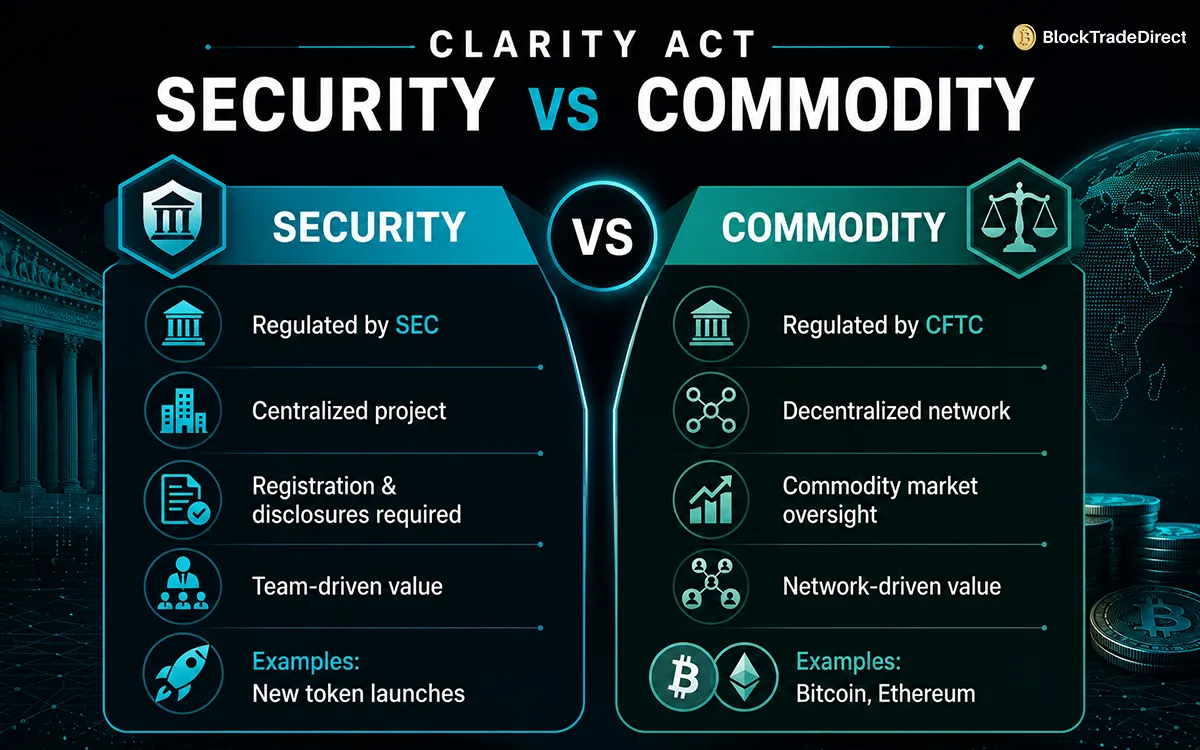
This is the part that matters most for your portfolio. The bill sorts digital assets into three buckets. Each bucket answers one question: who regulates it, and how closely?
|
Category |
Regulator |
Oversight level |
Examples |
|
Digital Commodity |
CFTC |
Lighter-touch |
Bitcoin, Ethereum |
|
Investment Contract Asset (Security) |
SEC |
Heavier - disclosures, registration |
New tokens tied to a company's ongoing efforts |
|
Payment Stablecoin |
Banking regulators |
Separate framework |
Dollar-pegged stablecoins |
A digital commodity gets its value from how people use the network. Not from promises made by a founding team. Bitcoin and Ethereum are the clearest examples. Nobody buys them because a company promised to make the price go up.
An investment contract asset is what the SEC has long called most other tokens. Its value depends on the ongoing effort of a central group, closer in spirit to a stock than a commodity. Under the CLARITY Act, these tokens stay under SEC rules. That means disclosure and registration requirements. Fintech attorney Rob Schwartz breaks down this distinction in detail on LinkedIn.
Here's what makes this more than a one-time sorting exercise. A token's label isn't set in stone. The bill creates a maturity test. It lets a network "graduate" from SEC oversight to the lighter CFTC rules, once it meets certain conditions. Mainly, the network can no longer be controlled by one central group. And the token needs real use within its own ecosystem.
In practice, a project can launch under SEC rules. Think of it like a company's IPO. Later, it can requalify as a digital commodity once it's decentralized enough. Issuers who use this path can raise up to $75 million in any 12-month period, according to the Congressional Research Service's official summary of the bill.
This is a real shift from today's system, where a token's legal status can flip based on which agency sues first.
Most explainers get this part wrong, because it moves fast. Here's the real state of play as of this week - not the hopeful version, not the doom version, just where the votes stand.
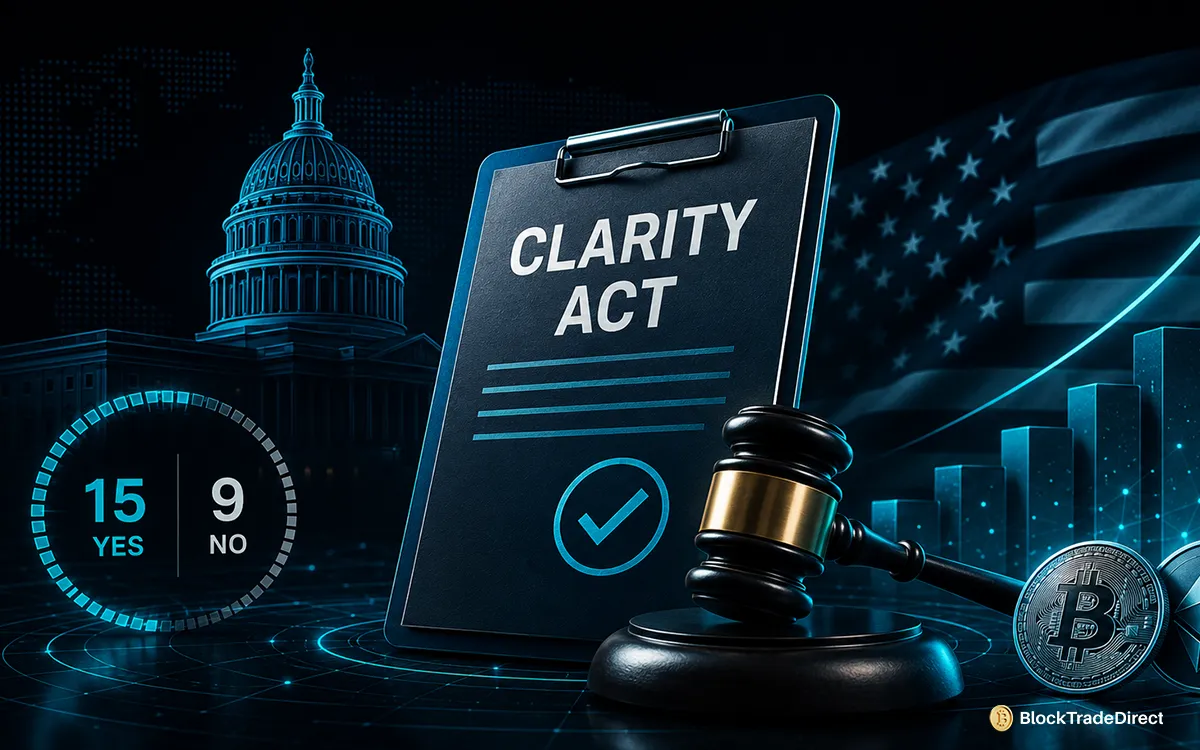
The bill cleared the Senate Banking Committee 15–9 on May 14. All 13 Republicans backed it. Two Democrats joined them: Ruben Gallego of Arizona and Angela Alsobrooks of Maryland. But a committee vote isn't a floor vote. Both senators said their support in committee didn't guarantee their vote on the floor.
Since then:
Not everyone reads this as bad news. Summer Mersinger, CEO of the Blockchain Association, has argued the real question isn't whether Congress passes crypto market rules, just when. Others look at the vote math and see a bill that's genuinely stuck, not just delayed.
Both views can be true at once. This bill has more momentum than any before it, and it still isn't law. If it doesn't clear the Senate before the August recess, its path gets much harder. The fall calendar runs straight into midterm election pressure.
None of this changes your trading account today. It's still a bill, not a law. But it helps to know what shifts if and when it's signed.
Here's how this bill fits into the bigger picture of US crypto regulation - and why understanding CBDCs vs Bitcoin for U.S. traders is an important part of the conversation.

The CLARITY Act is the closest the US has come to answering a question crypto has asked for a decade: is my token a security or a commodity, and who's in charge of it? The bill has real momentum. It passed the House by a wide margin. It won a Senate committee vote.
But it isn't law yet, and the Senate math is tight heading into a narrow summer window. Watch this one closely over the next few weeks. Whichever way it goes will likely set the tone for US crypto rules heading into 2027.
Want to see how current market structure rules affect what you can trade today? Open a trading account with BlockTradeDirect, explore trading and investment opportunities, and stay informed about key regulatory developments shaping the future of digital assets.
Regulators already treat Bitcoin and Ethereum as commodities. The CLARITY Act would turn that into permanent federal law, instead of leaving it up to whichever administration is in charge.
It sorts digital assets into SEC or CFTC oversight based on how decentralized the network is. It replaces years of case-by-case lawsuits with one written law.
No. It passed the House in July 2025 and cleared a Senate committee in May 2026. It still needs a full Senate floor vote, a merge with a companion bill, and a signature from the president.
A network the bill sees as no longer run by one central group. Once it hits that bar, the token can move from SEC oversight to the CFTC's lighter rules.
The GENIUS Act, already law, covers stablecoins only. The CLARITY Act is broader. It covers how every digital asset gets sorted into a security or a commodity.
For major tokens already treated as commodities, not much changes day to day. The goal is to lock that status into law. For smaller or newer tokens, it could mean less regulatory risk and wider exchange access over time.