


Pondering the purchase of your first Bitcoin or Ethereum? It doesn’t have all the mystery it used to. By the early part of 2026, crypto had progressed beyond the realm of coders and geeks. Exchanges have allowed you to buy it, and governments have sorted out the regulations in various regions worldwide, and you can pick up some in minutes as opposed to hours.
But the basics apply. Bitcoin, Ethereum, and other cryptocurrencies are assets, not stocks or bank accounts. You can do what you want regarding their acquisition, storage, and protection. But the trouble comes when people charge into investments without understanding the basics.
This guide is for first-time buyers who want a safe and straightforward way in. No hype, no information overload. Just the basics to let you buy Bitcoin or Ethereum with confidence, know what you own, and avoid common mistakes that are still costing people money today.
Purchasing crypto is better when you are aware of what you are actually making a trade off. Bitcoin and Ethereum are used interchangeably, yet these two were created with different intentions.
Bitcoin was initially developed as an electronic currency. Bitcoin was supposed to enable the transfer and preservation of value without involving the banks. It cannot be spent on a day-to-day basis, but instead it is a long-term store of value because its supply is fixed and predictable.
Ether is a blockchain with a computer program. It remains a useful currency, but what really works on top of it is what makes it strong. Ethereum is the foundation of apps, decentralized finance, NFTs, gaming, and tokenized assets. That makes it more adjustable, yet a little complicated for the novice.
|
Feature |
Bitcoin (BTC) |
Ethereum (ETH) |
|
Core purpose |
Digital money and value storage |
Platform for apps and smart contracts |
|
Supply model |
Fixed maximum supply |
Dynamic supply with fee burning |
|
Network usage |
Payments, long-term holding |
DeFi, NFTs, Web3 applications |
|
Volatility profile |
Generally lower |
Often higher due to activity |
|
Beginner friendliness |
Very high |
Moderate |
If your goal is simplicity and long-term holding, Bitcoin is often the starting point. If you are interested in how crypto is used beyond payments, Ethereum becomes more relevant.
Buying Bitcoin or Ethereum in 2026 is far safer than it was a few years back, though far from foolproof. The most substantial change has been the development of infrastructural maturity, where large exchange sites are now performing checks on user identity and holding users’ funds offline, along with sound regulations. This cuts down the incidence of large exchange collapses and/or fraud.
However, today the greatest threats involve user practices rather than platforms. Losses occur as a result of scams, poor passwords, or poor management of recovery phrases. Price volatility is also an aspect that hasn’t changed, particularly as a result of global news.
What has improved is the availability of choices. Newbies can buy very small amounts of their preferred cryptocurrencies, hold their coins in insured custodian services, or proceed to store their coins in their private wallets once they are ready.
Investing in Bitcoin safely can be made feasible for beginners, provided that the following are taken into consideration: take things slowly, use trusted platforms, and security must be an integral part of the process, not an action that comes afterwards.
Before you go ahead and purchase your first Bitcoin or Ethereum, make sure to have some basics in place. It is easy, and it will only result in problems down the line if not done.
There is no need for technical knowledge and equipment on your part. All you have to do is carefully set up and take security seriously right from the start.
Identity verification is a must before you can place an order or withdraw funds on most platforms. This is common in 2026 and makes the process much safer against fraud. The process of setting up an account is quick and only takes a few minutes, but approvals might take a bit longer during peak hours.
Once the fundamentals are established and prepared, the purchase process becomes easy and stress-free.
There is more than one way to buy Bitcoin or Ethereum, but not all options are equal for beginners. The best choice depends on how much guidance you want, how comfortable you are with custody, and how much you are buying.
For most first-time buyers, simplicity and safety matter more than advanced features or the lowest possible fees.
|
Methods |
Best for |
Why do people use it? |
Trade-offs |
|
Centralized exchanges |
Most beginners |
Easy buying, clear pricing, support |
You trust the platform with custody |
|
Crypto mobile apps |
First purchases |
Fast setup, simple interface |
Fees can be higher |
|
Traditional brokers |
Investors |
Familiar platforms, regulation |
Limited crypto features |
|
Peer-to-peer platforms |
Experienced users |
More control, local payments |
Higher risk for beginners |
Centralized exchanges: These are what most people start with in 2026 due to their convenience and relative ease of security compared to other options. These exchanges allow for small transactions, bank transfers, and tutorials, and also have wallet functionality so that you don’t have to work with keys at first.
For those who are new, the initial aim is not to make everything perfect. It’s just supposed to be a good first buy that’s easy to see and made on a reputable site. Eventually, you could choose something different or transfer to a personal wallet once you're more comfortable.
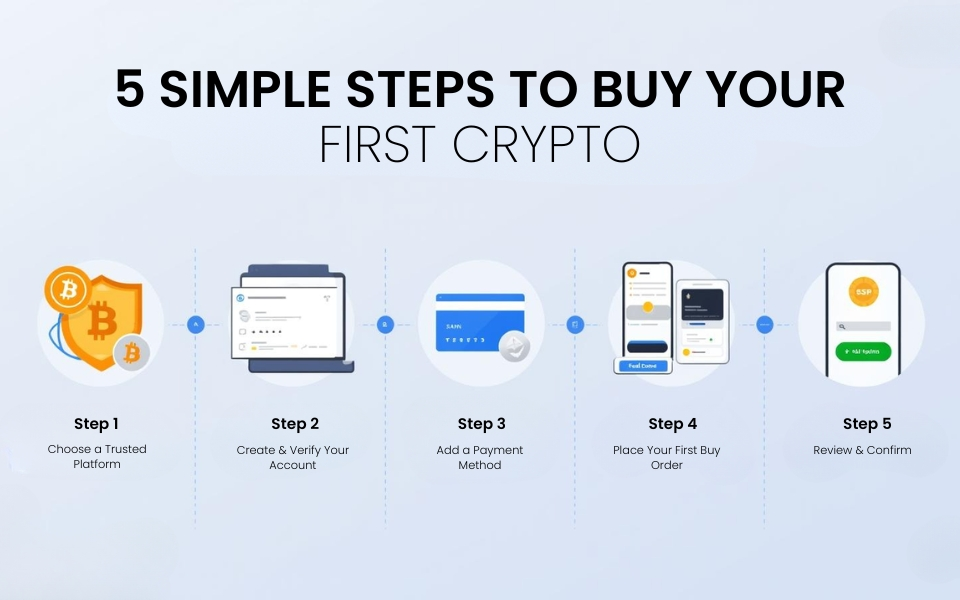
Once your setup is ready, the actual buying process is straightforward. Most platforms follow the same flow, even if the screens look slightly different. The key is to move slowly and double-check details before confirming anything.
Look for platforms that:
Avoid links sent through emails or social media. Always type the website or use the official app store.
You will be asked to:
Verification can be instant or take a few hours. This is normal and required on most platforms.
Most beginners use:
Credit cards are less common and often come with higher costs.
You can usually choose between:
For a first purchase, many beginners choose a small instant buy to keep things simple.
Before confirming, check:
Once confirmed, your Bitcoin or Ethereum will appear in your account wallet. At this point, you officially own crypto.
The next step is understanding where that crypto lives and how to store it safely.
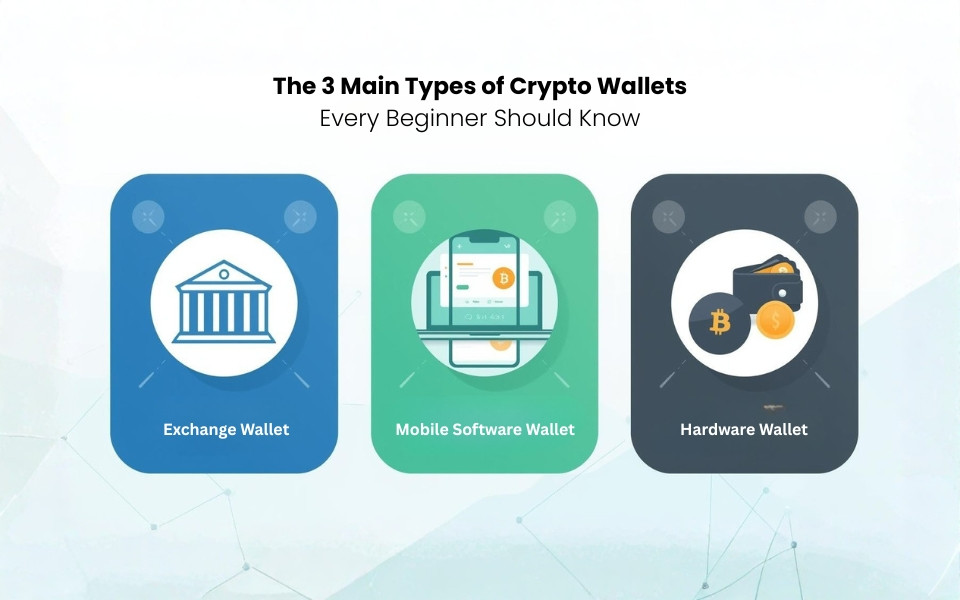
Once you purchase, you would like to know where it resides. This is where a crypto wallet comes in. A crypto wallet is where you can access your crypto on the blockchain. It does not hold coins like a physical wallet holds money, but holds access keys instead.
If you purchased using an exchange or app, your money is likely stored in an exchange-held wallet by default. This is okay for small transactions or short-term holdings, but true ownership requires an understanding of choices.
|
Wallet type |
What it is |
Security level |
Best used for |
|
Exchange wallet |
Wallet managed by the platform |
Medium |
First purchases, small balances |
|
Software wallet |
App on your phone or computer |
High |
Regular use and learning custody |
|
Hardware wallet |
Physical device storing keys offline |
Very high |
Long-term holding |
When you create a wallet yourself, you will receive a recovery phrase. It’s the master key to your money. If you lose the recovery phrase, nobody and no customer support team will help you regain access.
In most cases, having some small balances on these platforms while learning is acceptable for most new users. Once you amass some holdings, transferring crypto to a personal wallet is a significant step towards actual crypto ownership and security.
This is one of the most common questions new buyers ask, and the answer is simpler than it sounds. You do not need to buy a full Bitcoin or a whole Ethereum coin. Crypto is divisible, which means you can start with very small amounts and still participate.
For beginners, the goal is not to maximize returns. It is to learn how buying, holding, and securing crypto actually works without putting yourself under pressure.
Many beginners use a strategy called dollar cost averaging. This means buying small amounts at regular intervals instead of trying to guess the best price. It reduces stress and smooths out short-term price swings.
Purchasing a small amount of cryptocurrency helps you learn fees, confirmations, wallet dynamics, and market movement costs. All of this is far more important than earning profits in the long run. If you feel comfortable with your experience level, then you can scale up your investment or ride out.
It is not being conservative to start small, it is just common sense. For those looking to deepen their understanding,this guide on crypto investing tips provides practical strategies for risk management, timing, and discipline, which are essential before expanding your investment.
Buying Bitcoin or Ethereum is not just about the price you see on the screen. Fees and taxes can quietly eat into your purchase if you do not understand how they work. This catches many beginners off guard, especially on their first few transactions.
Most platforms are transparent in 2026, but the costs are spread across different steps. Knowing where they appear helps you avoid surprises.
|
Cost type |
When it applies |
What to know |
|
Trading fees |
Every buy or sell |
Usually, a small percentage |
|
Spread |
Instant or simple buys |
Price difference built into the rate |
|
Network fees |
When sending crypto |
Varies by network activity |
|
Withdrawal fees |
Moving off exchanges |
Fixed or variable by asset |
|
Taxes |
Selling or spending |
Depends on local regulations |
In many regions, buying and holding crypto does not trigger taxes. Selling at a profit usually does. Tracking transactions from the start makes future reporting much easier.
Understanding costs upfront keeps your first crypto experience calm and predictable, which is exactly what beginners need.
Most people who have a bad first experience with crypto did not lose money because they bought Bitcoin or Ethereum. They lost money because of avoidable mistakes. The good news is that these mistakes are well-known and easy to sidestep once you are aware of them.
Crypto rewards patience and caution far more than speed.
Here are some mistakes every beginner should watch out for:
No legitimate platform, wallet, or support agent will ever ask for your recovery phrase. If someone does, it is always a scam. There are no exceptions.
Taking a few extra minutes to verify links, confirm transactions, and secure accounts prevents most losses beginners face. Crypto does not forgive rushed decisions, but it rewards careful ones.
Avoiding these mistakes does not require expertise. It just requires slowing down and treating security as part of the process, not an optional step. Many first-time losses come from simple errors rather than price movements, which is why reviewing common crypto trading mistakes to avoid can save beginners a lot of frustration.
Buying Bitcoin or Ethereum is just the first step. What you do next matters just as much, especially if you want to avoid common mistakes and stay organized.
At this stage, the goal is not to constantly trade. It is to understand ownership, security, and long-term habits.
Next steps to take to secure and grow your crypto:
If you plan to hold long-term, price fluctuations matter less day to day. What matters more is keeping access secure and understanding how your crypto fits into your broader financial picture.
As you gain confidence, you can explore the features like staking, Ethereum-based apps, or recurring buys. There is no rush. Crypto rewards people who learn steadily. Once you are comfortable buying and holding, learning the basics of market behavior through crypto trading for US investors can help you make more informed decisions over time.
Buying your first Bitcoin or Ethereum in 2026 is more accessible than ever, but the responsibility still sits with you. Start small, choose trusted platforms, and treat security as part of the investment, not an extra step.
You do not need perfect timing or deep technical knowledge to begin. You just need patience, clear expectations, and a willingness to learn. Crypto is not about rushing in. It is about understanding what you own and why you own it. For readers who want a broader understanding of how exchanges, strategies, and market mechanics fit together, this complete cryptocurrency trading guide connects the bigger picture.
Yes. Both Bitcoin and Ethereum are divisible into very small units. Most platforms let you start with a small amount, sometimes as low as a few dollars.
In many regions, buying and holding crypto is legal, though rules vary. Some countries regulate exchanges heavily, while others focus on taxes. Always check local guidelines before investing large amounts.
If you lose your recovery phrase or private keys, access to your crypto is permanently lost. There is no reset option. This is why secure backups are critical.
Ethereum tends to be more volatile because it supports many applications and network activity. Bitcoin is often seen as more stable, but both carry risk.
Most beginners are better off holding. Trading requires experience, discipline, and time. Learning the basics first usually leads to better decisions later.