


Crypto trading is not one-size-fits-all. An approach working for one trader might be completely wrong for another in such a market that never sleeps and moves fast.
These are day trading and swing trading, which are the most common. Although both aim at taking advantage of price fluctuations, they are radically different in terms of the time commitment, amount of risk involved, the level of stress, and the approach used. These disparities are more significant in crypto than stocks because it is more volatile, open 24/7, and has easy access to leverage.
As the decade of the 2020s begins, the crypto markets keep maturing: they become increasingly liquid, trading tools are becoming more advanced, and retailers are not going to leave. On the other hand, unexpected price changes, news-induced volatility, and fee designs continue to play a crucial role in punishing traders who have picked the wrong style for their circumstances.
The following guide breaks down day trading vs. swing trading in crypto in a practical way. You are going to learn how each of these strategies works, the real pros and cons, common strategies traders use, and how to decide which approach fits your time, capital, and risk tolerance.
Crypto day trading means opening and closing positions within the same day. Sometimes the trades last hours, and at other times, just minutes. The idea remains very simple: catch small price movements before the market might change again.
Because crypto trades 24/7, day traders are not confined to the market hours as stock traders are. Many focus on the most liquid pairs, especially Bitcoin and Ethereum, where tight spreads combined with high volume make fast entries and exits possible.
Day trading very much relies on technical analysis. Traders will also be watching very short timeframes, such as 1-minute, 5-minute, or 15-minute charts. Decisions are based more on indicators, price action, order flow, and volume rather than long-term fundamentals.
Day trading indeed can be profitable, but it requires focus, discipline, and emotional control. Small mistakes compound quickly when the trades are more frequent. That is why so many beginners fail to handle it, especially in volatile crypto conditions.
Crypto swing trading involves capturing larger price movements of several days or even weeks. Instead of reacting to every minor fluctuation, swing traders try to profit from broader market trends, shifts in momentum, and other large-scale situations.
A normal swing trading strategy is held long enough for a trend to develop, but not so long that it becomes a longer-term investment. This makes swing trading popular with traders who cannot monitor charts all day but still want active exposure to crypto markets.
Swinging traders employ a combination of technical analysis and market context. The higher time frames here are the 4-hour, daily, and weekly charts. Most traders enter into trend continuations, breakouts, or pullbacks into key support and resistance levels.
Swing trading reduces the pressure of constant decision-making, but it introduces overnight risk. News events, macro shifts, or sudden market sentiment changes can affect open positions while you are away from the screen.
Day trading and swing trading aim for the same outcome, profit from price movement, but they operate on very different timelines. Understanding these differences upfront helps avoid choosing a style that does not match your schedule, risk tolerance, or mindset.
Here is a clear side-by-side breakdown.
|
Factor |
Day Trading |
Swing Trading |
|
Trade duration |
Minutes to hours |
Days to weeks |
|
Number of trades |
Multiple per day |
A few per week |
|
Time commitment |
Very high |
Moderate |
|
Overnight exposure |
None |
Yes |
|
Stress level |
High |
Medium |
|
Trading fees impact |
Significant |
Lower |
|
Chart timeframes |
1m to 15m |
4h to daily |
|
Best suited for |
Full-time traders |
Part-time traders |
Neither approach is inherently better. The better choice is the one that fits how you trade, how much time you can commit, and how you handle pressure.
Day trading attracts a lot of attention in crypto, mostly because of the speed and intensity. It looks exciting, but the reality is more demanding than most people expect. Here is an honest look at where it shines and where it breaks down.
Day trading rewards precision and discipline, but it punishes hesitation and overtrading. For many traders, the mental load is the biggest challenge.
Swing trading is often seen as the calmer alternative to day trading, but that does not mean it is risk-free. It trades speed for patience and constant action for structure. Here is how it really plays out.
Swing trading reduces stress and screen time, but it demands trust in your analysis and the discipline to let trades develop.
Day traders rely on repeatable setups that work on short timeframes. The goal is not to predict big moves, but to extract small, high-probability gains while managing risk tightly.
Here are the most commonly used day trading strategies in crypto markets.
Best for experienced traders who can stay focused and act quickly.
Works well during high-volume market sessions.
Common in sideways or low-trend conditions.
Day trading strategies demand strict risk control. Even a strong setup can fail quickly if execution or discipline slips.
Swing traders focus on structure and follow-through. They care less about short-term noise and more about whether the price is moving in a clean, repeatable direction. Trades take longer, but the setups are often clearer.
Here are the most widely used swing trading strategies in crypto.
This is one of the most consistent swing strategies in trending markets.
Works best when levels are respected across multiple timeframes.
Often combined with the price structure for confirmation.
Swing trading rewards patience and planning. The goal is not constant action, but placing fewer, higher-quality trades with defined risk.
Swing trading works best when trades are planned in advance rather than rushed. Clear entry zones, predefined stop-loss levels, and realistic profit targets matter more than constant chart watching. This approach is easier to build once you understand core trading mechanics and market structure from the ground up.
If you are still building that foundation, start with Crypto Trading 101 for US Investors before moving into more complex strategies.
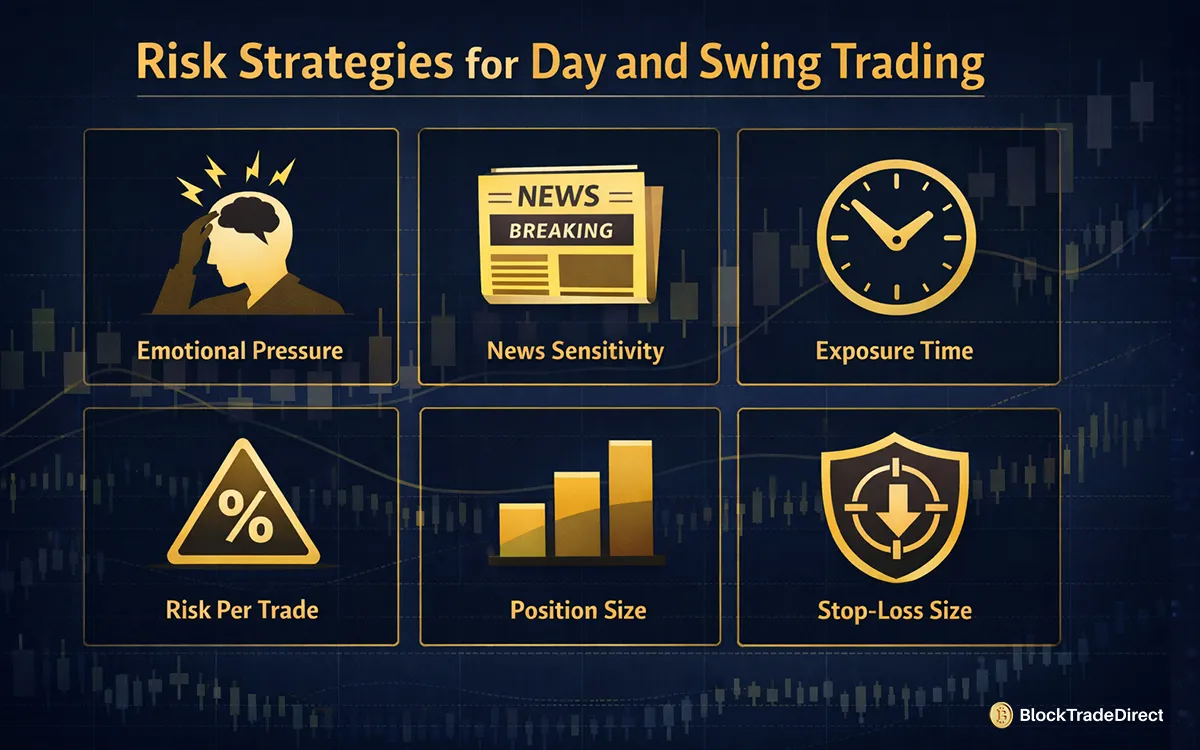
Risk management is where most traders actually win or lose. The strategies may look different, but how risk is handled matters more than entry timing.
Day trading and swing trading manage risk in very different ways because of trade duration and exposure.
|
Risk Factor |
Day Trading |
Swing Trading |
|
Stop-loss size |
Very tight |
Wider |
|
Position size |
Smaller |
Larger |
|
Risk per trade |
Lower, repeated |
Higher, fewer trades |
|
Exposure time |
Intraday only |
Multi-day |
|
News sensitivity |
Low overnight |
High overnight |
|
Emotional pressure |
High |
Moderate |
Both styles require strict rules. The difference is not how much risk you take, but when and how long you carry it.
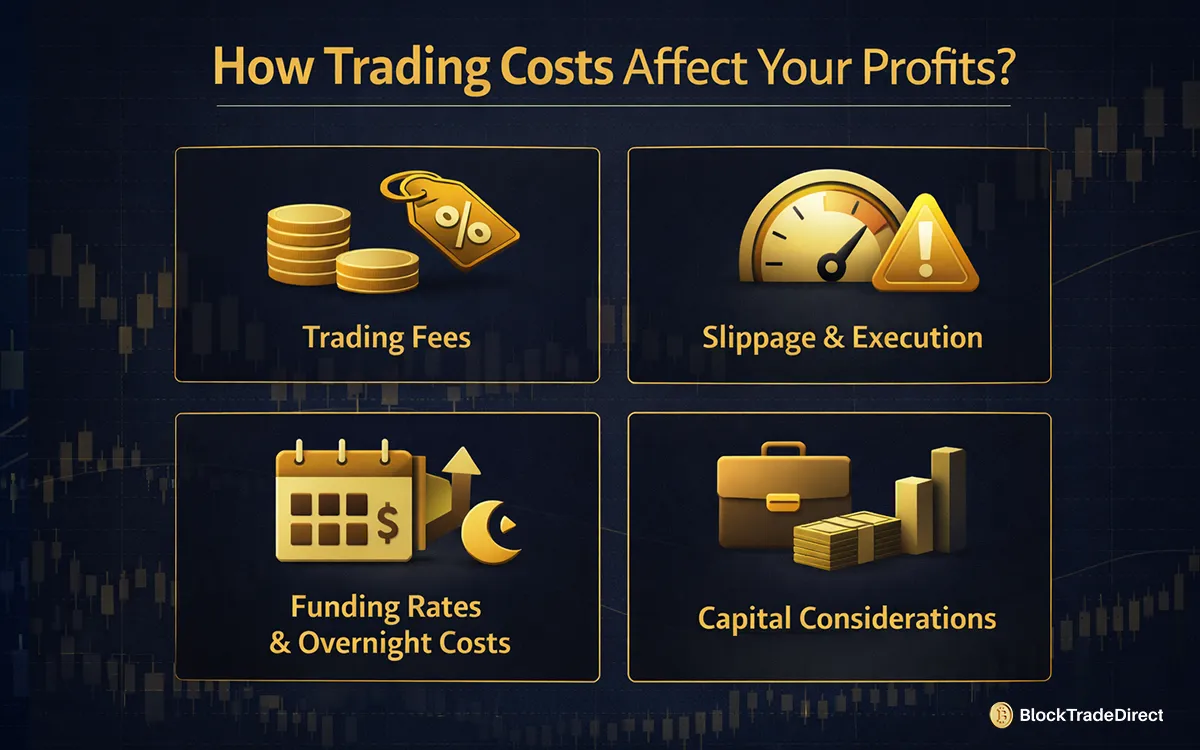
Trading costs quietly shape long-term results. Many strategies look profitable on paper but fail once fees, slippage, and funding costs are factored in. This is where day trading and swing trading diverge sharply.
Day traders place many trades, so even low fees add up fast. Entry and exit fees apply to every position, and frequent trades magnify their impact. Swing traders trade less often, which keeps total fee exposure lower over time.
Many traders underestimate how platform features, fee structures, and execution tools affect real performance, especially when trading frequently. Choosing the right setup can materially change results over time.
This is where understanding Advanced Trading Tools for US Investors becomes especially useful.
For smaller accounts, fees can be the deciding factor. Many traders discover that a slower approach keeps more of their profits intact.
Crypto trading in 2026 looks more mature than it did a few years ago, but it is still unforgiving to poorly chosen strategies. The biggest change is not volatility. It is how traders approach risk and execution.
Retail participation remains strong, especially in derivatives. Industry reports going into 2026 show that more than 60 percent of crypto trading volume now comes from perpetual futures rather than spot markets. That shift favors active strategies, but it also increases liquidation risk for undisciplined traders. Another major trend is the rise of automation and AI-assisted tools.
More traders now use:
Fee awareness has also increased. Traders are becoming more selective, focusing on fewer, higher-quality trades rather than nonstop activity. This trend has pushed many retail traders away from pure day trading toward swing-based or hybrid approaches.
Finally, risk management education has improved. In 2026, consistent traders prioritize capital preservation first and profits second. That mindset shift matters more than any indicator.
There is no objectively better trading style. The better choice is the one you can execute consistently without burning out or breaking your rules.
Use this quick framework to narrow it down.
Most successful traders test both styles before committing. Many end up using a hybrid approach, day trading only during high-conviction setups and swing trading the rest.
Before committing to day trading or swing trading, it helps to slow things down. Most early losses come from rushing into a style that does not match experience or discipline.
Spot markets remove liquidation risk and make mistakes less expensive. They are a better training ground than leveraged futures.
Keeping a simple trading journal helps identify patterns, mistakes, and emotional decisions. Over time, this matters more than any indicator.
Understanding market structure, basic indicators, and risk management gives you an edge no strategy can replace.
Day trading and swing trading both work in crypto, but only when they match the trader using them. Speed, discipline, and screen time favor day trading. Patience, planning, and structure favor swing trading.
What matters most is not how often you trade, but how well you manage risk and follow your rules. Crypto markets reward consistency and punish emotional decisions, regardless of strategy.
If you are just starting, slower often wins. Many traders grow more steadily by learning swing trading first, then adding day trades selectively as experience improves. Others thrive on fast execution and constant engagement.
The right approach is the one you can repeat calmly, manage responsibly, and stick with through good and bad periods. Start small, stay disciplined, and let your results guide you.
Yes, but only for a small percentage of traders. Day trading can be profitable if fees are controlled, risk management is strict, and execution is consistent. Most beginners struggle because frequent trades amplify mistakes and emotional decisions.
Swing trading is generally considered lower stress and more forgiving, but it is not risk-free. It reduces overtrading and fee pressure, yet carries overnight and news-related risk. Safety depends more on risk control than strategy type.
There is no fixed minimum, but small accounts face challenges. Fees, slippage, and limited margin for error make day trading harder with low capital. Many traders find swing trading more suitable when starting with smaller balances.
Yes. Swing trading is often better for beginners because it allows more time for analysis, fewer trades, and less emotional pressure. It also makes it easier to learn market structure and trend behavior.
Day traders often rely on short-term indicators like RSI, MACD, VWAP, and volume. Swing traders focus more on moving averages, trendlines, support and resistance, and higher-timeframe RSI divergence.
Leverage is not required for either. While some traders use leverage to increase exposure, it also increases liquidation risk. Many consistent traders focus on spot or low-leverage setups, especially early on.
Yes. Many experienced traders use a hybrid approach. They swing trade the broader trend and day trade selectively during high-conviction intraday setups. This requires clear rules to avoid overtrading.