

Cryptocurrency has experienced a whole change rather than remaining with its initial concept of Bitcoin and similar coins. At the beginning of the year 2026, over 25,000 cryptocurrencies were already listed on international exchanges, and this figure keeps on rising as more and more new projects are launched.
There are various purposes of different cryptocurrencies; some are digital currencies, others help in the development of blockchain applications, represent ownership of assets, etc. Others still support lending through distributing loaning methods or act mainly as community tokens for speculative purposes.
This huge variation is a double-edged sword for the investors.
Just like crypto should not be bought without knowing its category, investments in companies also need recognition of their types that are banks, tech firms, or startups burning cash. The market's real behavior can differ a lot even though two assets look alike on a price chart.
For example, stablecoins are constantly at a very small range of price movement, while memecoins can double or crash in just hours. DeFi tokens, on the other hand, are very sensitive to interest rate changes, hacking incidents, and protocol upgrades. Regulatory pressure is a regular problem for privacy coins. NFTs, in contrast, have completely different demand cycles.
Choosing the type of cryptocurrency that you wish to invest in helps you to:
The guide below highlights the main cryptocurrency classifications that every investor should know in 2026, states what each type is intended for, and illustrates how they belong to the larger crypto ecosystem.
First, it is necessary to clarify one main difference: coins and tokens before investigating the particular categories of stablecoins or DeFi tokens.
They are often considered ''cryptocurrencies'' in a broad sense; however, from a technical perspective, they are not identical.
The coin is on its own blockchain.
Usually, it is set up to function as a digital currency or to decentralize and support a network. A coin's role includes paying transaction fees, giving rewards to validators or miners, and moving value among users.
Some common examples are:
A coin will go away if the blockchain does.
A token is built on top of an existing blockchain, most commonly Ethereum, BNB Chain, or Solana.
Tokens are created using smart contracts and can represent many things:
Popular examples include:
Tokens depend on the blockchain they run on. If Ethereum stopped working, most Ethereum-based tokens would stop working too.
|
Feature |
Coins |
Tokens |
|
Own blockchain |
Yes |
No |
|
Runs on another blockchain |
No |
Yes |
|
Main purpose |
Payments, network security |
Utility, governance, assets, DeFi |
|
How they are created |
Blockchain protocol |
Smart contracts |
|
Examples |
BTC, ETH, SOL |
USDT, UNI, AAVE |
Recognizing this discrepancy simplifies the subsequent crypto classifications significantly, because most of the digital currencies you'll encounter next are indeed tokens and not coins.
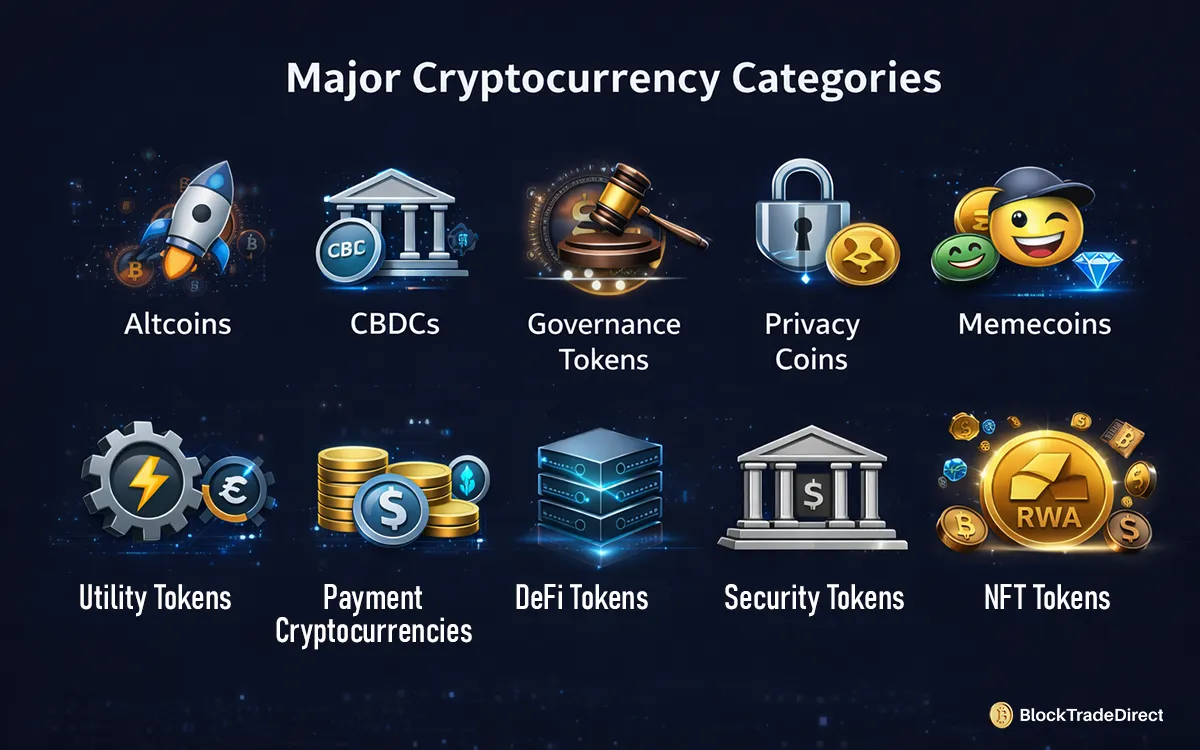
The moment you get the coins and tokens difference clear, the next thing to do is to learn how to group cryptocurrencies according to their usage. These classifications illustrate what a crypto asset is supposed to do, not just how it is constructed.
The following are the major types that every investor should be aware of in the year 2026.
Payment cryptocurrencies were the first application of blockchain technology. They are created from digital currency that can be sent to anyone instantly and directly without the involvement of banks or third-party payment processors.
The coins are built for security, decentralization, and good transactions.
Some well-known ones are:
Common use cases:
Things investors should know:
Payment coins are usually considered the “blue chips” of crypto, especially Bitcoin, but they are not risk-free.
Altcoin simply means “alternative to Bitcoin.”
Every cryptocurrency that is not Bitcoin falls into this category, including Ethereum, Solana, stablecoins, and thousands of smaller projects. Because of this, altcoins range from serious technology platforms to short-lived experiments.
Altcoins commonly include:
Why investors care about altcoins:
The history of altcoins is characterized by many failures, but there are also coins that grow up to be the main platforms with billions of dollars in market capitalization.
Want a deeper dive into altcoins, investing strategies, and risk management? Read our complete altcoins investing guide.
Stablecoins are digital currencies that are meant to be stable, usually at a value of 1 US dollar.
They tackle one of the major drawbacks of cryptocurrencies, which is volatility. Rather than going through the extreme price changes of Bitcoin or Ethereum, stablecoins try to be as unchanging as possible.
There are three main types:
Examples: USDT, USDC
Example: DAI
Why investors and traders use stablecoins:
2026 trend snapshot:
Want to learn more? Read our guide explaining crypto stablecoins.
Utility tokens give holders access to a product or service inside a blockchain platform. They are not meant to be investments in a company, even though many people trade them that way.
Common uses include:
Popular examples:
Things to keep in mind:
Want to go deeper? Read our complete guide on crypto token types and use cases.
Security tokens represent real financial assets on the blockchain. They are similar to traditional securities like stocks or bonds, but issued digitally.
Security tokens can represent:
Key characteristics:
Why this category matters:
In 2026, tokenized real-world assets are one of the fastest-growing areas of blockchain adoption, especially in real estate and private equity.
DeFi tokens power decentralized finance platforms that replace traditional financial services with smart contracts. These platforms let users lend, borrow, trade, and earn interest without banks or brokers.
Popular examples:
What DeFi tokens are used for:
Why investors watch this category:
2026 trends:
For deeper content, go through the guide on DeFi and the Future of Finance.
NFTs, or non-fungible tokens, represent unique digital ownership on the blockchain. Unlike Bitcoin or stablecoins, NFTs are not interchangeable. Each one is different.
Common use cases:
How this category has evolved:
Investor considerations:
Memecoins are cryptocurrencies built around internet culture and online communities.
They often start as jokes, but some grow into multi-billion-dollar assets due to social media attention.
Famous examples:
What makes memecoins unique:
Why people still invest:
Risks:
Privacy coins are designed to make transactions hard or impossible to trace on public blockchains. While most blockchains show wallet addresses and transaction amounts openly, privacy coins hide this data using cryptography.
Popular examples:
Key features:
Why some users prefer them:
Investor risks:
Governance tokens give holders the right to vote on decisions within a blockchain protocol or decentralized app. Instead of a company board making decisions, token holders shape how the platform evolves.
Common examples:
What holders can vote on:
Benefits:
Limitations:
Governance tokens are typically a part of the DeFi tokens for investors, but they are still a separate category that deserves to be clearly defined.
The CBDCs represent the digital counterparts of fiat money, created with the help of the centralized systems that are similar to blockchain technology. Although they aren't decentralized cryptocurrencies, they are, however, in direct competition with crypto when it comes to payments and digital finance.
Examples:
How they differ from crypto:
2026 landscape:
CBDCs won’t replace decentralized crypto, but they will shape how digital money works globally.
By now, it’s clear that “cryptocurrency” is a broad label, not a single asset type. Each category behaves differently, carries different risks, and serves a different purpose.
This table gives investors a quick way to compare the major types covered so far.
|
Category |
Main Purpose |
Common Examples |
Typical Risk Level |
|
Payment Coins |
Digital money and value transfer |
Bitcoin, Litecoin |
Medium |
|
Altcoins |
All non-Bitcoin cryptocurrencies |
Ethereum, Solana |
Medium to High |
|
Stablecoins |
Price stability |
USDT, USDC, DAI |
Low to Medium |
|
Utility Tokens |
Access to platforms and services |
BNB, LINK, BAT |
Medium |
|
Security Tokens |
Tokenized financial assets |
Tokenized stocks, real estate |
Medium |
|
DeFi Tokens |
Decentralized finance services |
UNI, AAVE, MKR |
High |
|
NFT Tokens |
Digital ownership |
BAYC, ENS, gaming NFTs |
High |
|
Memecoins |
Community and speculation |
DOGE, SHIB, PEPE |
Very High |
|
Privacy Coins |
Anonymous transactions |
Monero, Zcash |
High |
|
Governance Tokens |
Protocol voting rights |
UNI, MKR, COMP |
Medium |
|
CBDCs |
Government digital money |
eCNY, Digital Rupee |
Low |
No category is “best” for everyone.
Some investors prefer the relative stability of Bitcoin and stablecoins, while others seek higher returns through DeFi or newly minted altcoins. Knowing the position of an asset in this table makes it simpler to decide if its risk is compatible with your objectives.
There is not just one “best” kind of cryptocurrency. The right choice varies according to the amount of risk you can tolerate, your investment horizon, and your actual needs as far as crypto is concerned.
It is advantageous to check a few practical factors before making any purchase.
First, look at your risk tolerance
Some categories are just more volatile than others.
If you cannot handle the discomfort that comes with big price swings, then stay away from high-risk categories altogether.
Match the crypto type to your goal
Ask what you are trying to achieve:
Check the fundamentals
Before investing in any category, review:
Simple checklist
Knowing the type of crypto you are buying won’t eliminate risk, but it will prevent most beginner mistakes.
No matter which category you invest in, every cryptocurrency comes with risk. Some are obvious. Others only show up when markets turn ugly. Understanding these early helps you avoid expensive mistakes.
Crypto prices can move 10 to 30 percent in a single day. Smaller tokens can move even more. This affects payment coins, DeFi tokens, NFTs, and memecoins alike.
If you need money in the short term, crypto is a poor place to park it.
Governments continue to reshape crypto rules.
New regulations can:
This risk is especially high for privacy coins, stablecoins, and security tokens.
Many tokens rely on smart contracts.
Bugs or exploits can lead to:
Even audited projects have failed this way.
Crypto scams keep evolving.
Common examples:
Retail investors lose billions each year to fraud. If returns sound guaranteed, they are almost always fake.
When you keep crypto on an exchange, you rely on that company.
Risks include:
Self-custody reduces this risk but adds responsibility.

The crypto market keeps changing, but some patterns are becoming clear as 2026 begins. New categories are emerging, while others are slowly losing relevance.
Here are the trends investors are watching most closely.
More companies and governments are putting real assets on blockchains.
This includes:
These assets are issued as security tokens or regulated stablecoins. The goal is faster settlement, global access, and fractional ownership.
Banks and trading firms are no longer ignoring decentralized finance.
They are using private or permissioned DeFi platforms for:
This is pushing DeFi tokens toward stricter compliance and slower, more stable growth.
Governments want stablecoins to behave more like digital cash.
Expect:
Large, regulated stablecoins are likely to dominate smaller projects.
AI platforms are issuing tokens to:
This is becoming a new subcategory of utility tokens, especially on Ethereum and Solana.
Instead of one giant blockchain doing everything, newer systems are splitting tasks across multiple chains.
Tokens linked to:
are becoming more common.
Memecoins will not disappear, but investor behavior is changing.
After repeated crashes, many traders are:
Crypto is slowly becoming less chaotic and more structured, even if volatility remains.
Cryptocurrency is not a single investment category. It is a mix of very different assets with different goals, risks, and long-term potential.
Some cryptocurrencies aim to replace money. Other power apps represent ownership, enable lending, or exist mainly for speculation. Treating them all the same is one of the most common mistakes new investors make.
Once you understand the major types of cryptocurrency, it becomes much easier to:
If you want to explore specific categories in more depth, your cluster guides on altcoins, stablecoins, tokens, DeFi, NFTs, memecoins, and privacy coins will help you go further.
In crypto, knowing what you are buying matters just as much as when you buy it.
There is no fixed number, but cryptocurrencies are commonly grouped into categories like payment coins, stablecoins, utility tokens, DeFi tokens, NFTs, memecoins, privacy coins, governance tokens, and CBDCs. Each category serves a different purpose in the crypto ecosystem.
Not always, but many tokens depend on smart contracts and specific platforms, which adds extra risk. Coins like Bitcoin and Ethereum tend to be more stable compared to smaller utility or DeFi tokens.
Beginners usually start with large payment coins like Bitcoin or Ethereum and stablecoins for practice. These are easier to understand and have better liquidity than newer token categories.
Stablecoins are less volatile, but they still carry risks such as issuer failure, regulatory action, or reserve problems. They are safer than most crypto assets, but not risk-free.
Altcoins refer to all cryptocurrencies other than Bitcoin. Tokens are assets built on existing blockchains. Many altcoins are actually tokens, but not all tokens are altcoins in the technical sense.