


Large price swings in Bitcoin can occur within hours and sometimes even minutes. Movements of this nature are not random; rather, they are consequentially driven by how the crypto market is wired, how traders react to news, and the fact that Bitcoin trades around the clock across the world.
As we head into early 2026, BTC remains more volatile than most traditional assets, even with more institutional money in the market. The volatility in the price of BTC creates some real opportunities but also raises the risk of Bitcoin trading for those who are not prepared. Understanding crypto market volatility is the first step toward smarter trading decisions.
This guide explains why Bitcoin is so volatile, how it compares with other assets, and what those price movements actually mean for traders.
Volatility describes both the speed and the amplitude of an asset's price movement over a certain period. In Bitcoin markets, this generally means swift changes in both directions within even a single day, driven by news, trader behaviour, or sudden changes in supply and demand.
Unlike traditional markets, Bitcoin trades 24/7 with no closing bell. There are no circuit breakers to pause trading during extreme moves. Because of this constant activity, BTC price fluctuations are far more frequent and visible than those in stocks or commodities.
More simply put, Bitcoin volatility reflects:
Greater crypto market volatility means greater profit potential for traders, while simultaneously raising the Bitcoin trading risk. For this very reason, volatility must be understood first before a leverage or short-term strategy is implemented.
That said, it puts the volatility of Bitcoin into context. Against more traditional assets, such as stocks or gold, the moves of Bitcoin's price are larger and more frequent. In fact, this is one of the major reasons traders are drawn to the BTC markets.
Bitcoin is still a relatively young asset and a much smaller market overall. This means price changes react much quicker to changes in capital inflows, outflows, and shifts in sentiment. More traditional markets absorb a shock far more slowly.
|
Asset |
Typical Volatility Level |
Market Behavior |
|
Bitcoin (BTC) |
High |
Sharp daily and weekly price swings |
|
S&P 500 |
Low to moderate |
Gradual moves, rare extreme spikes |
|
Gold |
Low |
Slow, defensive price action |
|
Nasdaq |
Moderate |
Tech-driven swings, limited by market hours |
While volatility in Bitcoin has declined over the years, it remains several times higher than major equity indices. In 2026, this institutional participation has flattened some of the extreme moves seen in the past, yet macro events, regulatory news, and crypto-specific news still lead to frequent BTC price fluctuations.
This increased crypto market volatility is what presents traders with an opportunity and a risk simultaneously. Next, we will break down the core reasons as to why Bitcoin behaves this way in the first place.
Volatility in Bitcoin is driven not by a single factor, but rather by several mutually strengthening structural and behavioral forces. Knowing these drivers helps explain why sudden, powerful changes in BTC price can occur.

Because Bitcoin's market is still relatively small compared to the global stock or bond markets, its price may swiftly change with massive buy or sell orders.
Lower liquidity means:
This effect becomes even stronger during off-peak hours or on weekends.
Bitcoin has a hard-capped supply of 21 million coins, and new supply enters at a predictable rate, which is adjusted every four years through events known as halvings.
This creates volatility because:
These supply shocks tend to amplify Bitcoin price swings.
A lot of Bitcoin trading volume comes from derivatives markets. Both futures and perpetual contracts enable traders to use leverage, amplifying profits and accentuating losses.
High leverage results in:
The major contributor to crypto market volatility is this.
Headlines are everything to Bitcoin. Major price swings can be expected with updates in regulation, ETF flows, macroeconomic data, and events at major exchanges.
Sentiment-driven moves often occur because of:
Markets can be moved in minutes with positive or negative narratives.
Bitcoin never closes. It trades across time zones, across regions, across economic systems, without a break.
This leads to:
The always-on nature of Bitcoin amplifies both opportunity and Bitcoin trading risk.
Bitcoin is volatile, but it is still more stable compared with most altcoins. This is because Bitcoin has deeper liquidity, broader adoption, and stronger market trust compared to smaller crypto assets. It is during those moments of general market instability that traders usually move their capital back into BTC.
Smaller altcoins have generally experienced larger and quicker price swings. Lower trading volume and thinner order books make them much more sensitive to sudden buying or selling pressure. This means that the BTC price tends to exhibit more controlled fluctuations compared to smaller tokens.
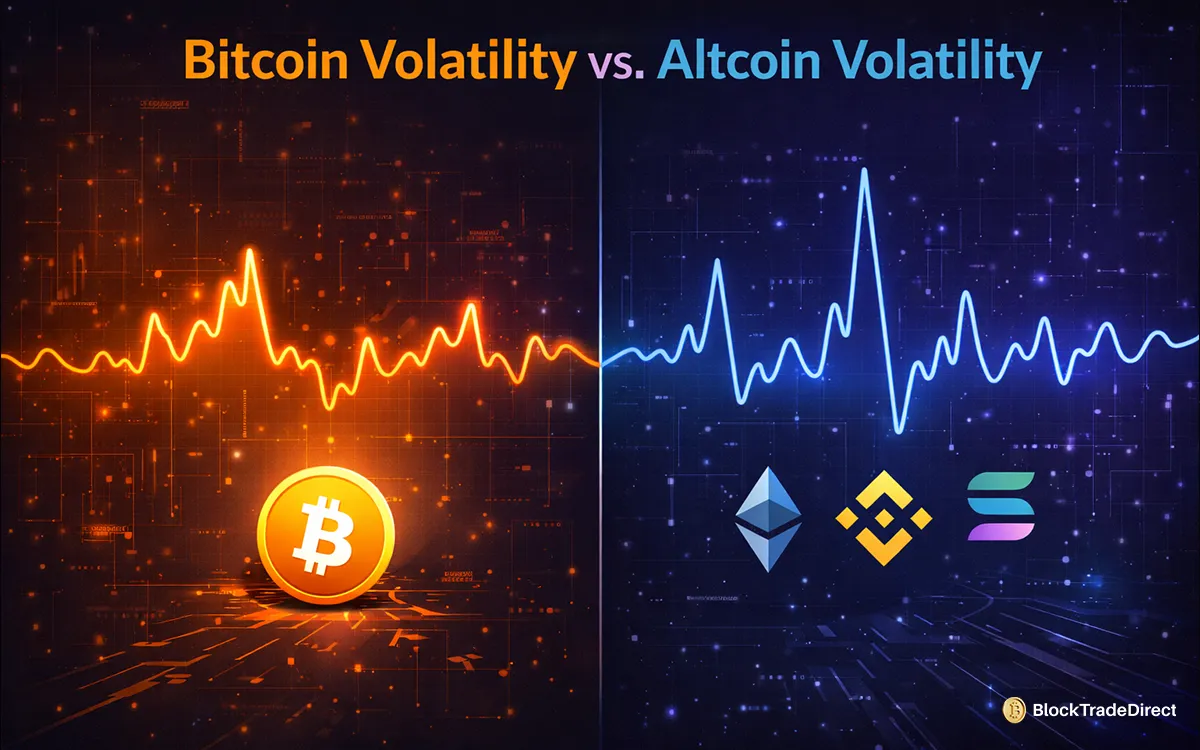
Key differences of Bitcoin from altcoins:
During periods of market stress, Bitcoin dominance tends to rise. This reflects traders reducing risk by shifting away from highly volatile assets. While Bitcoin volatility remains much higher than more traditional markets, it is often viewed as the “least risky” option within the crypto market.
The volatility of Bitcoin has gone down, but not completely disappeared, compared to its very early years. While large percentage swings are less common than they were ten years ago, sharp moves still occur around big events. This is indicative of Bitcoin maturing but not of stabilizing.
Reasons for this change include increased market participation. Institutional investors, spot ETFs, and regulated trading platforms have given more depth to the market. Greater liquidity absorbs shocks, but it does not eliminate fluctuations in the price of BTC.
Trends Shaping Bitcoin Volatility in 2026:
Now, Bitcoin reacts more like a risk asset during global uncertainty. Volatility tends to spike around interest rate decisions, inflation data, and regulatory announcements. While the long-term trend points toward moderation, crypto market volatility remains a defining feature for traders.
How traders approach the market directly depends on volatility. Large price swings open up more opportunities for profit in shorter timeframes, while drastically increasing the possibility of losses sooner. For traders, volatility is something to work with, not avoid.
Short-term traders generally benefit the most from BTC price fluctuations. Their momentum moves, breakouts, and rapid trend shifts might happen within hours. At the same time, its volatility punishes poor risk control, especially when the use of leverage comes into play.
Because of these risks, much emphasis is placed by traders on discipline and preparation. Learning how volatility interacts with leverage, position sizing, and execution is critical before one enters active trades. Most people start with learning the basic mechanics of Bitcoin trading and the market behavior on BlockTradeDirect before moving into advanced strategies.
Managing BTC volatility is less about predicting price direction and more about controlling risk. Traders apply structured rules to stay consistent when the price of BTC accelerates in either direction. Without a plan, volatility quickly turns from opportunity into loss.
Risk management tools assist traders in surviving unpredictable markets while remaining active.
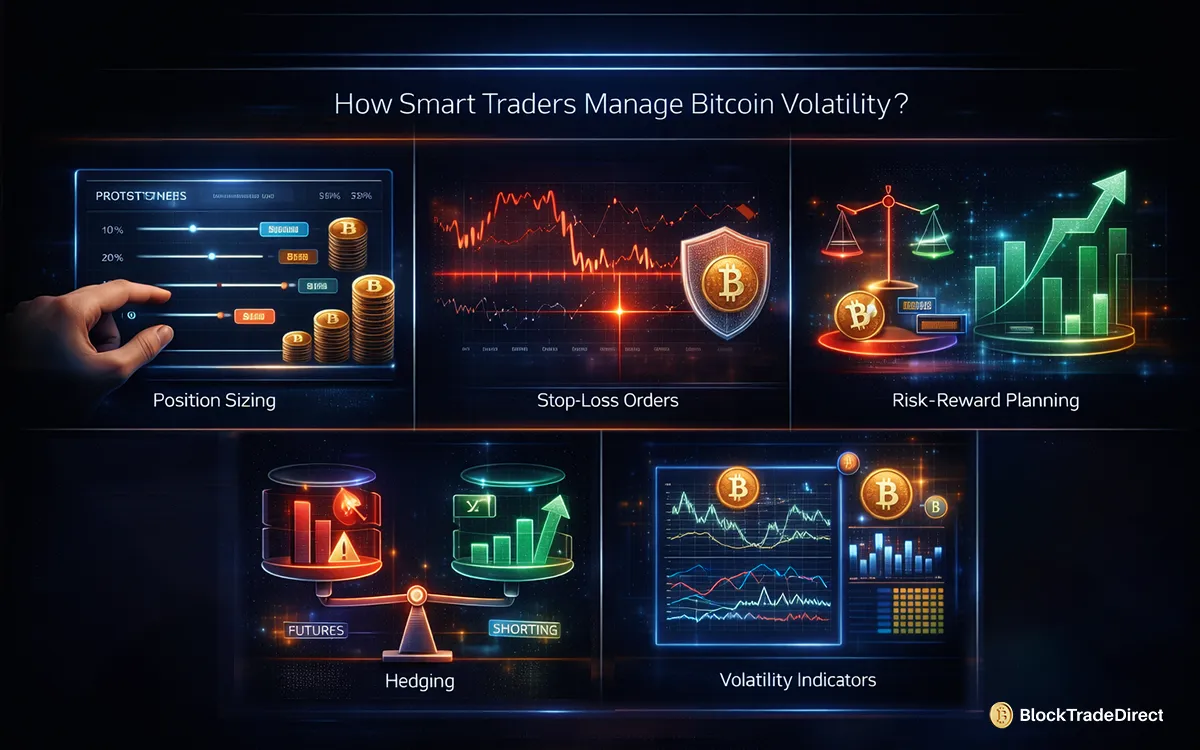
|
Strategy |
How It Helps Traders |
|
Position sizing |
Limits exposure per trade |
|
Stop-loss orders |
Caps downside during fast moves |
|
Risk–reward planning |
Keeps losses smaller than gains |
|
Hedging |
Reduces net market exposure |
|
Volatility indicators |
Improves entry and exit timing |
Tools traders commonly use:
Common trading tools include:
The traders who understand the risk of Bitcoin trading focus on being consistent rather than attempting to get in on every move. Structured risk management allows them to stay in the market long enough to benefit from crypto market volatility, instead of getting wiped out by it.
Bitcoin volatility is neither a good nor a negative phenomenon. It will rely on the approach taken by a trader to the market. To traders in the market, it is an opportunity. To the participants who are unprepared, volatility may raise the chances of blunders and losses.
Big changes in the price of BTC enable the trader to record significant changes without following months or years. Simultaneously, weak strategies and emotional decision-making are very easily revealed due to volatility. This is the reason why most new traders find it difficult to cope with fast markets.
Volatility is a growth process of Bitcoin in terms of the market. The extreme moves end up being lower as the adoption goes up, yet price swings are one of the fundamental elements. Volatility is not a threat to traders, but a tool, and it should be followed by clear rules and the respect of the risks of trading in Bitcoin.
Bitcoin has no market close and 24/7 trading and is less liquid than regular assets. BTC price fluctuations are much more rapid compared to stock markets due to news, sentiment changes, and leveraged trading.
Volatility of Bitcoin has been reduced over the years, though abrupt changes do happen. Price fluctuations in 2026 will be more associated with macro events, ETF flows, and derivatives activity than basic speculation.
Volatility in itself is something that can be quantified but not accurately predicted. Historical volatility and ATR are risk estimation tools used by traders to predict future precision.
Greater volatility depicts greater potential in profits, but it is riskier to trade Bitcoin. Volatility results in a loss increase instead of a gain without adequate position sizing and stop-loss rules.