


Crypto started as a new kind of money. Web3 turns it into a new kind of financial system.
The new system brings practical benefits to traders and investors while remaining theoretical. Web3 technology establishes new rules for asset control, trade execution, liquidity sources, and market transparency. Users can trade through their wallets, connect with smart contracts, and access worldwide markets without using centralized exchanges.
The new trading ecosystem allows users to create decentralized exchanges, on-chain trading bots, and yield strategies that were not available in traditional crypto trading just a few years ago. The system brings forth new security threats that require users to manage their personal custody responsibilities.
This guide explains Web3 to readers by showing its definition, its differences from basic crypto investing, its impact on actual trading methods, and its suitability for their trading methods in 2026.
Web3 represents the next internet evolution, which enables users to control their data, digital assets, and personal identities through blockchain technology.
People use crypto wallets to connect with platforms instead of using an email and password combination. Smart contracts manage transactions through automated processes that occur on public blockchains without relying on companies to handle fund storage or trade processing.
Crypto traders and investors can execute trades without requiring any central authority because they can exchange assets through their wallets. Decentralized pools provide liquidity to the market. On-chain systems handle order settlement. The system enables users to prove ownership through transparent methods.
The establishment of Web3 technology does not eliminate cryptocurrency. It expands the operational possibilities of cryptocurrency. The digital assets include Bitcoin and other tokens. Web3 functions as the framework that enables users to move and create passive income from assets while they interact with decentralized applications.
|
Feature |
Web2 Platforms |
Web3 Platforms |
|
Asset custody |
Platform holds your funds |
You control your wallet |
|
Identity |
Email and account login |
Wallet address |
|
Market access |
Restricted by region |
Open globally |
|
Transparency |
Limited |
Fully on-chain |
|
Downtime risk |
Platform outages possible |
Network based |
The connection between crypto and Web3 remains intact because both technologies preserve their distinct identities while sharing essential links.
The category of cryptocurrency includes digital currencies such as Bitcoin and Ethereum together with various exchangeable tokens that people use for payment or storage. The decentralized technology stack known as Web3 enables those assets to be utilized within applications independently of centralized businesses.
People use standard exchanges to trade cryptocurrency because these platforms operate separately from Web3. The Web3 environment becomes accessible to you when you operate a trading bot that uses smart contracts, when you link your wallet to a decentralized exchange, or when you lend your tokens through a protocol.
Here is the simplest way to look at it:
|
Crypto |
Web3 |
|
Digital money and tokens |
Decentralized applications and infrastructure |
|
Used for trading and payments |
Used for trading, lending, governance, NFTs, and more |
|
Focus on price and market cycles |
Focus on ownership and automation |
Understanding this difference helps traders avoid confusion and spot real opportunities, especially when new Web3 projects claim to offer more than just another token.
Web3 trading is built on a few core technologies. You do not need to be a developer to use them, but understanding how they work helps you trade smarter and avoid common mistakes.
Smart contracts are programs stored on a blockchain that execute trades and financial actions automatically when conditions are met.
For traders, they are used to:
Once deployed, smart contracts cannot be changed, which makes audits and protocol reputation important.
DEXs allow users to trade directly from their wallets without depositing funds into an exchange account.
Key traits:
Prices are set algorithmically based on supply and demand inside liquidity pools.
Wallets replace user accounts in Web3. They store private keys and approve transactions.
Common types:
Your wallet controls your funds. If you lose access, there is no password reset.
Blockchains cannot access real-world prices on their own. Oracles feed market data into smart contracts.
They are used for:
Reliable oracles are critical for fair and accurate trading.
Web3 does more than move trading onto the blockchain. It changes who controls the process, how strategies are executed, and what kind of tools traders can use.
Instead of depositing funds into an exchange, traders keep assets in their own wallets.
This means:
It also means full responsibility for security.
Web3 platforms do not operate within national borders.
Traders can:
This reduces friction, especially during high-volatility events.
Automated trading has moved on-chain.
Web3 bots can:
This has made algorithmic trading accessible to smaller traders, not just institutions.
Every transaction is public.
Traders can:
This level of visibility does not exist in traditional markets.
Web3 has introduced instruments that barely existed a few years ago:
These tools allow more complex strategies without relying on centralized intermediaries.
Web3 is not only about faster trades. It opens up new ways to earn, participate, and diversify beyond simply holding tokens.
Investors can earn passive income by:
Returns vary based on demand, risk, and market cycles, but these options give investors more control over how capital is used.
Many Web3 projects distribute tokens directly to users through:
This allows investors to enter before centralized exchange listings, often at lower valuations.
Token holders can vote on:
This turns investors into active participants rather than passive holders.
Web3 now supports tokenized versions of:
This gives crypto investors exposure to traditional assets while staying on-chain.
Assets can move between blockchains using bridges, opening access to multiple ecosystems without selling positions.
For a deeper look at how decentralized finance fits into long-term investing, see our guide on DeFi and the future of finance.
Web3 gives traders more control, but that control comes with real risks. Understanding them is part of using the ecosystem responsibly.
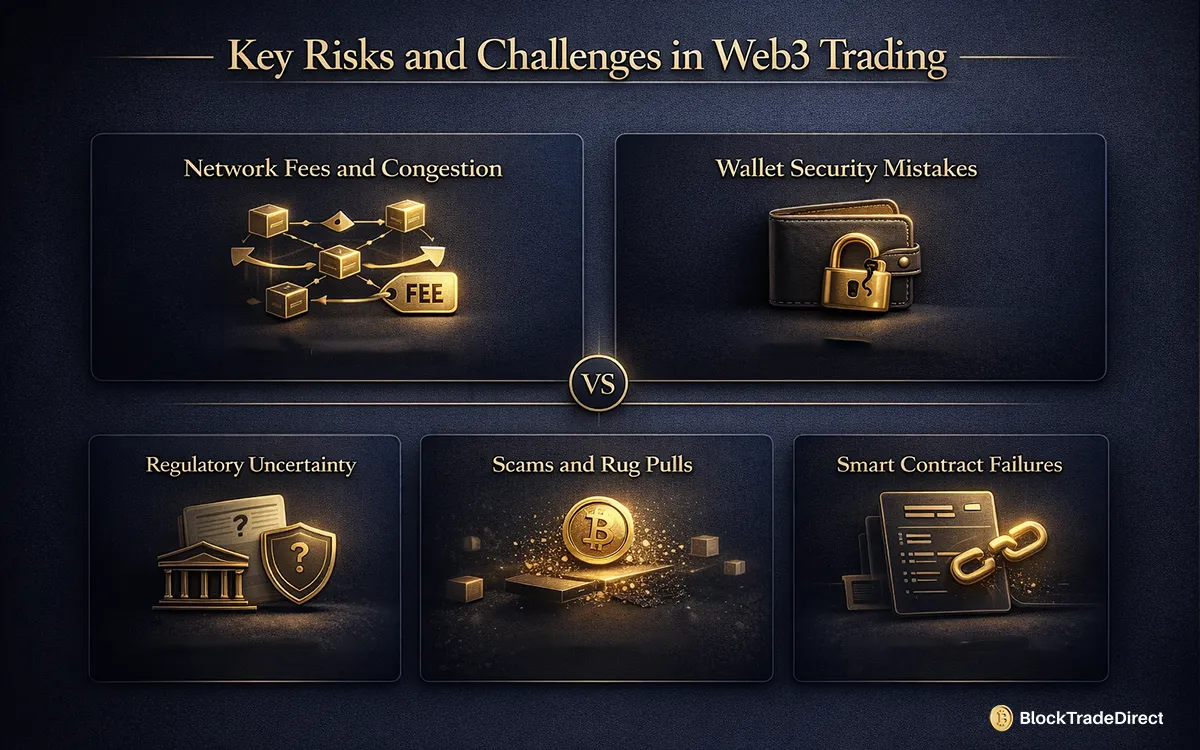
A single bug in a contract can lock or drain funds permanently. Even popular protocols have suffered exploits in the past.
Anyone can launch a token or app.
Common traps include:
Rules around decentralized platforms are still evolving in many countries. Changes in compliance requirements can affect access, taxation, or protocol operations.
There is no customer support desk in Web3.
Losing your seed phrase or signing a malicious transaction can result in permanent loss.
During market spikes, transaction fees can rise sharply, reducing profitability for short-term trades.
|
Risk |
How to Reduce It |
|
Smart contract exploits |
Use audited, established protocols |
|
Fake tokens |
Verify contract addresses |
|
Wallet compromise |
Use hardware wallets |
|
Phishing sites |
Bookmark official URLs |
|
High fees |
Trade during low congestion |
The Web3 technology now exists as a fundamental component that powers most cryptocurrency trading activities. The technology has developed from its early test stage into a system that enables most cryptocurrency trading activities.

The year 2026:
The direction is clear: Web3 is no longer a side experiment. Modern cryptocurrency markets now depend on Web3 technology for their essential operational functions.
Web3 trading does not happen on a single dashboard. It runs on a stack of tools that together replace the role of traditional exchanges and brokers.

Most active traders and long-term investors rely on:
The advanced strategies that traders use today require them to combine multiple trading tools. Our breakdown of advanced trading tools for crypto investors shows important indicators, charting systems, and automation features that experienced market participants use in their actual trading work.
The self-custody system requires users to implement stronger security measures. The correct wallet configuration with transaction approvals and storage methods enables users to achieve stable growth while avoiding dangerous errors. This overview of how crypto investors protect their assets covers the practical safeguards most Web3 users rely on today.
Web3 trading and centralized exchange trading solve different problems. One focuses on control and transparency. The other focuses on convenience and speed.
Centralized platforms are still easier for beginners. They offer familiar interfaces, customer support, and simple fiat onramps. For short-term traders who value fast execution and deep order books, they can feel more predictable.
Web3 platforms, on the other hand, give users direct ownership of funds and full visibility into how trades are processed. There is no need to trust a company to safeguard assets or remain solvent. Trades are settled on-chain and can be verified by anyone.
Neither approach is objectively better for everyone. Many active traders use both. They enter through centralized exchanges and deploy capital into Web3 protocols for specific strategies like yield farming, on-chain arbitrage, or decentralized derivatives.
|
Feature |
Centralized Trading |
Web3 Trading |
|
Ease of use |
High |
Medium |
|
Control over funds |
Low |
High |
|
Trading fees |
Medium |
Variable |
|
Security model |
Platform dependent |
User dependent |
|
Privacy |
Limited |
High |
You do not need to overhaul your entire setup to start using Web3. Most traders ease into it step by step.
A simple path looks like this:
Most mistakes happen early, when people rush. Moving slowly at first costs little and teaches a lot.
Not every crypto asset plays the same role in Web3. Some are built for payments, others for running applications, securing networks, or powering decentralized finance.
Web3 users typically interact with:
If you are deciding which assets are most actively traded and used by market participants, this overview of popular cryptocurrencies among US traders breaks down where real liquidity and adoption are concentrated today.
Understanding which tokens are actually used inside Web3 applications helps investors separate long-term infrastructure projects from short-term speculation.
Web3 is not replacing centralized trading overnight, and it does not need to.
What it offers is something different: direct ownership, transparent markets, and access to financial tools that operate without middlemen. For traders, this means new strategies and deeper visibility into market behavior. For investors, it opens doors to yield, governance, and tokenized assets that did not exist in traditional systems.
The learning curve is real, and so are the risks. But for those willing to understand how wallets, smart contracts, and decentralized platforms work, Web3 has already become a practical part of modern crypto trading.
In 2026, it is no longer just an experiment. It is another layer of the market. One that smart traders and investors are learning to use alongside everything else.
Web3 can be safe, but it depends on how carefully you use it. Reputable protocols, audited smart contracts, and proper wallet security reduce risk. Most losses happen due to phishing, fake tokens, or poor key management rather than problems with the technology itself.
No. Many traders use both. Centralized exchanges are useful for fiat deposits and high-liquidity trades, while Web3 platforms are often used for decentralized trading, DeFi strategies, and self-custody.
Popular software wallets are fine for daily use, but hardware wallets are safer for larger balances. The best choice depends on how often you trade and how much security you want versus how much you value convenience.
Yes, but beginners should start slowly. Using small amounts, learning how transactions work, and understanding gas fees make the experience much smoother and reduce costly mistakes.
Not in the near future. Web3 and centralized exchanges serve different purposes. Most of the market will likely continue using both, depending on the type of trade and the level of control needed.