


Crypto markets in early 2026 appear more mature, but they remain far from predictable. Bitcoin and Ethereum now trade alongside ETFs, institutions move size on-chain, and regulations are clearer in many regions. None of that has removed volatility. In fact, faster capital flows and global participation often amplify price swings.
That is the reason why cryptocurrency analysis is more crucial than ever. Prediction and hype-based decisions hardly ever last in real market conditions. Traders and investors relying on systematic analysis usually make quiet and consistent choices, especially when it comes to strong price ups or sudden price downs.
One of the important roles of cryptocurrency analysis is to answer three vital questions. Is the project truly worth the money? Is the price moving in or out of a good zone? Is the blockchain activity that proves the legitimacy of the market move really happening?
No one approach can provide a complete view. The value is revealed by fundamental analysis. Timing is shown by technical analysis. The behavioral aspect is described by on-chain analysis. The ability to connect these points has become a basic necessity rather than an advanced skill.
The remainder of this tutorial elaborates on each of the approaches in detail, indicating the spot where the strategy is most effective and describing how traders utilize it in actual crypto markets.
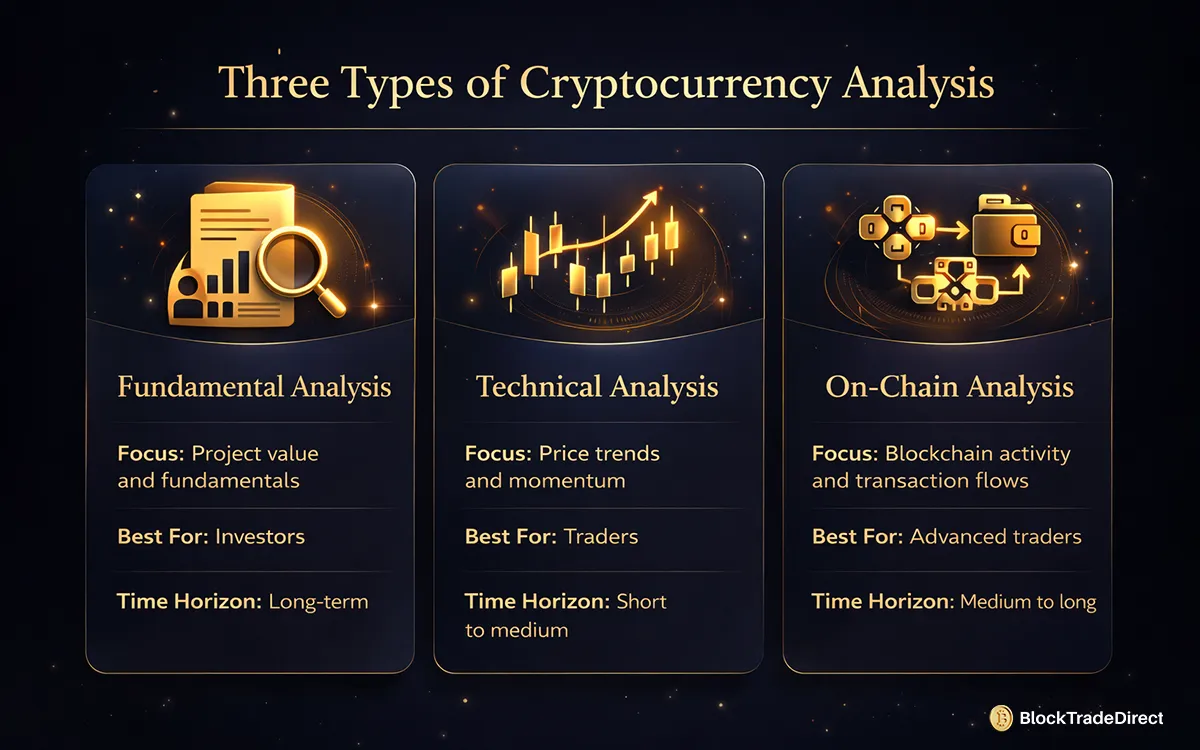
Before plunging into a more thorough treatment, it is good to illustrate the typical structure of cryptocurrency analysis. The majority of traders and investors depend on three principal methods. Each of them approaches the market from a different perspective and answers a different type of question.
Fundamental analysis is concerned with value. It determines whether a given crypto project is worth the money just through its usefulness, the team's capability, token design, and the potential for the future.
Technical analysis is concerned with price movement. It employs charts, patterns, and indicators to provide insight into the psychology of the market and to point out possible points of entry and exit.
On-chain analysis is concerned with blockchain data. It watches what really goes on in the network, such as the activity of wallets, the flow of transactions, and the movement of the supply, and not just the price.
These techniques do not compete with each other, but rather they are complementary. Fundamental analysis is often the mainstay for long-term investors. Day traders are technically analysis-based. The sophisticated market players are the ones who use on-chain data to either validate or contradict what price charts suggest.
|
Analysis Type |
What It Focuses On |
Best Suited For |
Typical Time Horizon |
|
Fundamental Analysis |
Project value and strength |
Investors |
Long-term |
|
Technical Analysis |
Price trends and momentum |
Traders |
Short to medium |
|
On-Chain Analysis |
Blockchain activity and flows |
Advanced traders |
Medium to long |
Understanding these three approaches sets the foundation for smarter decision-making. The next sections break each one down in detail, starting with fundamental analysis.

Fundamental analysis in crypto is about understanding whether a project has real value beyond short-term price moves. Instead of asking where the price is going tomorrow, it asks whether the project should exist and grow over the next few years.
Basically, crypto fundamental analysis is looking at the power, utility, and infinity of a blockchain project. This is significant as many coins may gain a lot of attention and thus, a high price through hype, but at the same time, very few of them will be able to last long enough to be really accepted and thus, be the very few that have real adoption.
Traders and investors usually look at a mix of qualitative and quantitative factors:
These metrics help assess whether a project is reasonably valued relative to its fundamentals.
Fundamental analysis is most effective for:
It is less useful for timing short-term trades, which is why most traders pair it with other analysis methods. Fundamental analysis is especially useful for investors who want to avoid emotional decisions and short-term hype. Many beginners struggle here because they jump into trades without a framework, which is a common theme covered in this guide on crypto trading mistakes to avoid.
Technical analysis focuses on price, volume, and market behavior. Instead of asking whether a project is good, it asks how traders are reacting to it right now. In fast-moving crypto markets, that distinction matters.
Crypto technical analysis is based on one simple idea. All known information is already reflected in the price. By studying charts, traders try to spot patterns that repeat because human behavior repeats, especially under fear and greed.
This approach is widely used in crypto because markets trade 24/7, liquidity shifts quickly, and sentiment can change within minutes. Technical analysis becomes far more effective once traders understand basic order types, market structure, and risk control. If you’re still building that foundation, this complete cryptocurrency trading guide breaks down how crypto markets actually work before diving into charts and indicators.
Most traders rely on a small set of repeatable tools rather than dozens of indicators:
The goal is not prediction. It is a probability. Technical analysis helps traders define risk and avoid emotional decisions.
Certain patterns appear frequently across timeframes:
These patterns help traders anticipate how the price may react around key levels, especially during high volatility.
Crypto prices often move before fundamentals change. News travels fast, leverage amplifies moves, and sentiment flips quickly. Technical analysis helps traders respond to what the market is doing, not what they hope it should do.
That said, technical signals can fail, especially in low-liquidity or news-driven conditions. This is why experienced traders combine chart analysis with broader context and risk management.

On-chain analysis is what makes crypto different from every other market. Stocks, forex, and commodities do not let you see how assets move at the network level. Blockchains do.
On-chain analysis looks at publicly available blockchain data to understand what participants are actually doing, not what price alone suggests. It answers questions like who is buying, who is selling, and whether long-term holders are accumulating or exiting.
Because blockchain data is transparent and verifiable, on-chain signals often provide early clues before the price reacts.
On-chain analysts track a wide range of metrics, but a few matter most:
As of early 2026, on-chain analysis is no longer niche. Institutions use it to monitor liquidity, risk exposure, and market structure. Retail traders have access to better dashboards and clearer metrics than ever before.
With more capital moving directly on-chain through DeFi, staking, and bridges, blockchain data often reflects shifts in sentiment before they appear on price charts.
On-chain analysis works best for:
On its own, on-chain data can be complex and easy to misread. Used alongside fundamental and technical analysis, it becomes a powerful confirmation tool. Next, we compare all three approaches side by side to show where each one fits best.
Each type of cryptocurrency analysis looks at the market through a different lens. None of them is complete on its own. Understanding where each one shines helps you use them correctly instead of expecting one method to do everything.
Fundamental analysis deals with the question of value. It helps to know if a project is worthy of long-term capital. It does that by looking at the project's utility, team, and economic design. Generally, it takes a long time and pays no attention to short-term noise.
Technical analysis is concerned with the issue of time. It concentrates on how price is affected by supply, demand, fear, and greed. It is a fast, reactive, and helpful method for specifying entries, exits, and risk.
On-chain analysis is an aspect of the human condition. It is not visible as such, but crypto activity is taking place on the blockchain directly. By doing so, it often connects the dots between fundamentals and price movements.
|
Aspect |
Fundamental Analysis |
Technical Analysis |
On-Chain Analysis |
|
Primary Focus |
Project value |
Price and momentum |
Blockchain activity |
|
Data Source |
Whitepapers, metrics, news |
Charts and indicators |
Public blockchain data |
|
Best For |
Investors |
Traders |
Advanced traders |
|
Time Horizon |
Long-term |
Short to medium |
Medium to long |
|
Main Strength |
Filters quality |
Improves timing |
Confirms conviction |
|
Main Limitation |
Slow signals |
False breakouts |
Complex interpretation |
The biggest mistake traders make is treating these methods as rivals. In reality, they work best together. Fundamentals tell you what to buy. On-chain data shows who is actually buying. Technical analysis helps decide when to act.
The most consistent crypto traders and investors do not rely on a single method. They layer analysis. Each approach answers a different question, and together they reduce blind spots.
A simple way to think about it is value, behavior, and timing.
Step 1: Use fundamental analysis to filter projects
Start by identifying cryptocurrencies with real utility, strong teams, and sustainable tokenomics. This narrows the universe and helps avoid low-quality or purely hype-driven assets.
Step 2: Use on-chain analysis to confirm market behavior
Once a project passes the fundamentals test, look at the blockchain data. Are long-term holders accumulating? Are tokens moving off exchanges? Is network activity growing? This helps confirm whether smart money behavior supports the thesis.
Step 3: Use technical analysis to time entries and exits
After value and behavior align, use price action to manage risk. Support levels, trend structure, and momentum indicators help decide when to enter, scale, or exit.
A trader might identify a fundamentally strong project with steady development. On-chain data shows rising active addresses and increasing exchange outflows, suggesting accumulation. The trader then waits for a technical breakout above resistance instead of buying impulsively.
This approach avoids chasing price, reduces emotional decisions, and improves consistency over time.
No framework guarantees profits. Markets change, narratives rotate, and volatility remains part of crypto. But combining all three analysis methods creates structure, which matters far more than predictions.
Combining fundamentals, on-chain data, and technical setups works best when paired with strong investing habits. Position sizing, patience, and realistic expectations matter just as much as analysis, which is why these 10 must-know crypto investing tips are worth reviewing alongside any strategy.
Although the traders with good tools and data have access, the majority still face difficulties owing to their analysis method, rather than the analysis itself being ineffective. Overconfidence, impatience, and ignoring context are the main causes of errors.
One of the typical mistakes is to depend on just one indicator or metric. A strong RSI signal or a spike in on-chain activity means nothing in isolation. These signals, without confirmation from other data, often lead to false confidence and poor timing.
Another fault is not taking into account market conditions. Technical setups act differently in strong trends, ranging markets, or during major news events. Using the same strategy everywhere is usually a recipe for disaster.
There are also a lot of traders who are misinterpreting on-chain data. Movements of large wallets do not necessarily imply buying or selling. Transfer between wallets, custodians' reshuffling, and the protocol's mechanics can distort the raw numbers if they are taken literally.
Analysis is a tool, not a guarantee. It works best when paired with patience, discipline, and clear risk limits. Avoiding these common traps often improves results more than adding new indicators.
There is no single best way to analyze cryptocurrency markets. The right approach depends on what you are trying to do and how much time and experience you bring to the table.
If your focus is long-term investing, fundamental analysis should be your starting point. It helps you avoid weak projects and stay grounded when prices swing wildly. If you trade actively, technical analysis becomes essential because timing and risk control matter more than narratives. If you want deeper conviction and earlier signals, on-chain analysis adds context that price charts alone cannot provide.
Most people do best by starting simple. Learn one method well before layering the others. As experience grows, combining fundamentals, on-chain data, and technical setups creates a clearer picture of value, behavior, and timing.
Crypto markets in 2026 are more transparent, more data-rich, and more competitive than ever. The edge no longer comes from secret indicators. It comes from structure, discipline, and understanding how different forms of analysis fit together.
Used correctly, cryptocurrency analysis does not eliminate risk. It helps you take smarter risks, with clearer reasons and fewer emotional decisions.
Fundamental analysis is usually the best starting point. It helps beginners understand what a project does, why it exists, and whether it has long-term potential. Technical and on-chain analysis make more sense once you understand how crypto markets work and how risk should be managed.
Yes, many short-term traders rely primarily on technical analysis. That said, using charts alone can lead to false signals, especially during news-driven or low-liquidity periods. Even basic awareness of fundamentals or on-chain data can improve decision-making and reduce unnecessary losses.
On-chain analysis has a steeper learning curve, but beginners can still use simple metrics like exchange inflows, outflows, and active addresses. You do not need to track every data point. Starting with a few clear signals is often more effective than trying to analyze everything.
That depends on your strategy. Long-term investors may review fundamentals and on-chain trends monthly or quarterly. Active traders often reassess technical setups daily or even intraday. The key is consistency, not constant monitoring.
No form of analysis guarantees profits. Cryptocurrency analysis helps you make informed decisions and manage risk, but losses are still part of trading and investing. The goal is not certainty. It is better odds, clearer reasoning, and fewer emotional decisions over time.