


Crypto didn't start as a multi-chain world.
At first, every blockchain tried to become the one network. Bitcoin stored value. Ethereum runs smart contracts. Later came Solana, Avalanche, and dozens more. Each improved speed, fees, or programmability, but they created a new problem. None of them could easily talk to each other.
So liquidity got trapped.
A token on one chain couldn't safely move to another without bridges. Bridges turned out to be fragile and became one of the biggest sources of hacks in the industry. The ecosystem kept expanding, but it stayed disconnected.
That's where interoperability comes in.
Instead of competing chains, the industry is shifting toward connected chains. Different blockchains handle different jobs while still sharing data, assets, and users. Both Polkadot and Cosmos were designed around this idea: the future will contain many blockchains that communicate rather than operate alone.
This changes how crypto works. Finance, gaming, identity systems, and applications stop living inside isolated networks and start behaving more like apps on the internet.
Now the real question begins.
Two major projects are racing to build this connected world, and they have chosen completely different approaches. Polkadot and Cosmos.
Before comparing them, it helps to understand what each one is trying to build.
Both networks sit below typical blockchains like Ethereum or Solana. They don't compete as single chains. They act as foundations where many chains can exist and communicate. People often call them Layer-0 networks.
The similarity ends there.
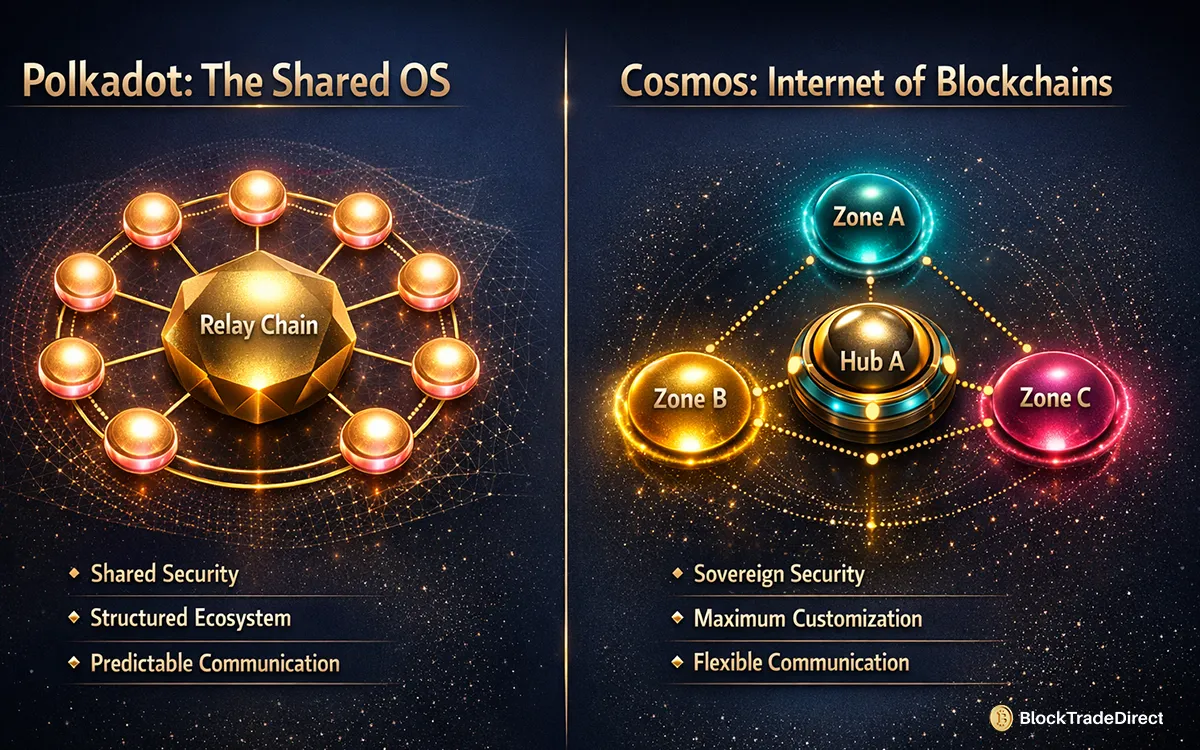
Polkadot focuses on coordination.
Instead of every blockchain securing itself, multiple chains plug into one central network called the relay chain. These connected chains are called parachains. They share validators, security, and communication rules.
In practice, this means a new project doesn't need to bootstrap its own validator network. It borrows trust from Polkadot's existing infrastructure. The network behaves like a shared operating system for blockchains.
Key characteristics
Cosmos focuses on independence.
Each blockchain is sovereign. It runs its own validators, its own governance, and its own token economy. Instead of sharing security, chains communicate through a messaging protocol called IBC, which works like standardized internet packets for blockchains.
So rather than one big system, Cosmos becomes a network of fully independent networks.
Key characteristics
Quick Comparison
|
Feature |
Polkadot |
Cosmos |
|
Core idea |
Shared security network |
Internet of independent blockchains |
|
Chain type |
Parachains |
App-specific chains (zones) |
|
Communication |
XCMP messaging |
IBC protocol |
|
Validator model |
One shared validator set |
Each chain has its own validators |
|
Flexibility |
Structured ecosystem |
Highly customizable ecosystem |
Now that the foundations are clear, the real difference comes from how they actually move data between chains.
Both networks promise cross-chain communication. The difference is how trust is handled while messages move between chains. Polkadot treats interoperability as a coordinated system. Cosmos treats it as communication between independent systems.

Polkadot uses a central chain called the relay chain to verify everything happening across the network.
Parachains don't trust each other directly.
They trust the relay chain.
So when Chain A sends tokens or data to Chain B:
This system is called XCMP (Cross-Chain Message Passing).
Because security is shared, a new chain immediately inherits the same protection level as the entire network. It doesn't matter if the project is small or new.
What this achieves:
Tradeoff:
Joining Polkadot requires fitting into its architecture. You gain safety but sacrifice some independence.
Cosmos removes the central verifier entirely.
Every chain keeps its own validators and sovereignty. Instead of sharing security, chains verify each other using cryptographic proofs through IBC (Inter-Blockchain Communication).
Here, Chain A proves its state to Chain B directly.
No central authority. No inherited security.
This makes Cosmos feel closer to the internet model. Servers don't share security; they verify packets.
What this achieves:
Tradeoff:
Security varies per chain. A weak validator set can still exist in the network.
|
Concept |
Polkadot |
Cosmos |
|
Trust model |
Shared trust |
Verified trust |
|
Security |
Network-level |
Chain-level |
|
Communication |
Enforced by protocol |
Voluntary via IBC |
|
Coordination |
High |
Minimal |
|
Flexibility |
Moderate |
Very high |
So the philosophical split becomes clear.
Polkadot says: secure everything first, then connect it.
Cosmos says: let chains be free, then let them communicate.
This is where the difference between the two networks really becomes practical.
Both allow chains to communicate. But they protect those chains in completely different ways.

An easy way to picture it:
Polkadot is like living inside a guarded apartment complex. Cosmos is like owning your own house in a large, connected neighborhood.
Every parachain uses the same validator pool.
So even a brand new project instantly benefits from the full network's security. Attackers would need to compromise the entire validator set, not just one small chain.
That removes one of the biggest risks in crypto: weak early-stage networks.
Advantages
Tradeoff
Projects depend on the relay chain rules and governance. You gain protection but give up some independence.
Each Cosmos chain runs its own validator set.
Security depends entirely on that chain's token value and validator participation. A large chain can be extremely secure. A small one can be vulnerable.
But the benefit is control.
Advantages
Tradeoff
Security quality varies across the ecosystem.
|
Situation |
Better Choice |
|
Launching a new project safely |
Polkadot |
|
Full independence |
Cosmos |
|
Institutional-grade reliability |
Polkadot |
|
Experimental or niche chains |
Cosmos |
So the question becomes less about which is safer overall and more about who controls the safety.
Technology matters, but ecosystems decide winners.
Developers choose platforms based on three things: how hard it is to launch, how much freedom they get, and where users already exist. Polkadot and Cosmos attract very different types of builders.
Polkadot is appealing when a team wants security handled from the start.
Instead of recruiting validators, managing token incentives, and defending against attacks, developers focus mainly on the application itself. The relay chain handles consensus and finality.
Projects that often prefer Polkadot
The environment feels structured. Chains are expected to cooperate rather than compete.
Cosmos attracts builders who want control.
A team can design its own tokenomics, fees, governance, validator rules, and upgrade schedule. The blockchain becomes a product, not just a smart contract platform.
Projects that often prefer Cosmos
The ecosystem grows more organically. Chains join the network when they decide that interoperability benefits them.
|
If your priority is |
Choose |
|
Fast secure launch |
Polkadot |
|
Full customization |
Cosmos |
|
Shared ecosystem liquidity |
Polkadot |
|
Independent economy design |
Cosmos |
|
Community-controlled networks |
Cosmos |
If you're still new to how different blockchain categories exist, a guide to different types of cryptocurrency can help you understand the broader world.
Interoperability sounds technical, but users notice it through speed and cost.
Both networks scale by running many chains in parallel. The difference is how predictable that performance stays as the ecosystem grows.
Polkadot processes transactions across multiple parachains at the same time while the relay chain finalizes them.
Because validation is centralized at the network level, throughput stays consistent even if one parachain becomes busy. The system behaves like lanes on a highway managed by one traffic controller.
What users typically experience
Limitation
The number of parachains is limited by network capacity, so scaling expands in controlled steps.
Cosmos scales horizontally.
Every chain processes its own transactions independently. If more demand appears, new chains can simply be created. There is theoretically no fixed ceiling because each zone adds its own throughput.
What users typically experience
Limitation
Quality differs across chains since each network maintains its own infrastructure.
|
Metric |
Polkadot |
Cosmos |
|
Scaling method |
Parallel secured chains |
Unlimited independent chains |
|
Performance consistency |
High |
Variable |
|
Maximum throughput potential |
Very high |
Practically unlimited |
|
Fee predictability |
Stable |
Chain-dependent |
|
Congestion impact |
Isolated |
Fully isolated |
Now that we know how they run, the next question is economic.
Both networks rely on staking and governance, but their tokens play very different roles inside the ecosystem.
In simple terms
DOT powers participation in a shared network
ATOM supports a coordination hub in a network of independent chains
DOT is tightly integrated into the system. You can't really participate in the network without it.
Primary uses
Because parachains rely on the relay chain, demand for DOT is directly connected to ecosystem growth. More projects joining means more tokens locked.
ATOM has a lighter role.
Individual Cosmos chains run on their own tokens, while ATOM mainly secures the Cosmos Hub and helps coordinate interchain services. Some chains use it heavily, others barely depend on it.
Primary uses
This design spreads value across many tokens instead of concentrating it into one.
|
Utility |
DOT |
ATOM |
|
Required for ecosystem participation |
Yes |
Not always |
|
Governance importance |
High |
Moderate |
|
Value tied to network growth |
Strongly |
Partially |
|
Dependency across chains |
High |
Low |
|
Token role |
Core infrastructure |
Coordination layer |
For investors trying to understand how token roles affect risk and strategy, our crypto investing guide breaks it down clearly.
The debate isn't only technical anymore. We can now look at actual usage patterns across the multichain ecosystem.
Interoperability has become one of the fastest-growing sectors in crypto because users no longer stay on a single chain. Assets move between DeFi platforms, games, identity systems, and payment networks. The market is shifting from “which chain wins” to “how chains connect.”
This trend is already visible in financial infrastructure, where blockchains are moving beyond experiments and starting to act as settlement layers across platforms. You can read How Blockchain is Revolutionizing the Finance Industry and explore the broader impact.
And this is where Polkadot and Cosmos start separating in practice.
Cosmos has seen strong real activity because joining the network is simple. A project launches its own blockchain and enables IBC when ready. That flexibility encouraged a wide range of specialized chains.
Current strengths
The ecosystem behaves like open internet standards. Anyone can plug in.
Polkadot adoption grows more slowly but tends to be structured. Projects enter through parachain slots and integrate tightly with the existing network from day one.
Current strengths
The network behaves more like a coordinated platform rather than an open federation.
|
Future Area |
Current Leader |
|
Live cross-chain usage |
Cosmos |
|
Structured ecosystem platforms |
Polkadot |
|
Experimental app-chains |
Cosmos |
|
Security-focused infrastructure |
Polkadot |
If you want a practical understanding of how these ecosystems affect traders and market behavior, a complete cryptocurrency trading guide helps.
There isn't a single winner because they are solving two different versions of the same problem.
Cosmos focuses on connecting independent blockchains.
Polkadot focuses on building a secure multichain environment.
Right now, Cosmos leads in real cross-chain activity. Many production networks already move assets using IBC, and developers launch specialized chains quickly without waiting for approval or shared infrastructure. It behaves like an open network that anyone can join.
Polkadot, however, leads in integrated design. Its shared security and coordinated communication make it easier to build complex applications that rely on multiple chains working together safely. The ecosystem grows more slowly but tends to be more tightly connected.
The likely outcome isn't one replacing the other.
Cosmos resembles the open internet, where networks stay independent but communicate. Polkadot resembles a unified operating system where components share a common foundation.
The multichain future probably uses both models together.
Not universally. Polkadot prioritizes shared security, while Cosmos prioritizes independence. The better option depends on whether a project values safety or sovereignty more.
IBC connects separate blockchains that verify each other. Parachains share a single validator network that verifies all chains collectively.
Cosmos currently shows more real cross-chain usage because chains can join freely and communicate without slot limits.
DOT value is closely tied to network participation, while ATOM’s value is spread across a broader ecosystem. Risk profiles differ, rather than one being strictly better.
Yes. They represent two complementary architectures for a multichain world and may eventually interconnect through external bridges and protocols.