


For quite some time, the finance sector around the globe relied on the centralized banks and financial institutions. They were the ones who would move money, verify ownership, and manage trust. The system, though functional, was slow, expensive, and pretty much unevenly available. Making payments across borders still took days, settlements were dependent on a number of intermediaries, and there was little transparency.
Blockchain technology fundamentally alters the way financial systems work. Rather than putting faith in a single institution, transactions are authenticated by means of cryptography and distributed ledgers. This subsequently increases the amount of visibility, the speed, and the resistance to fraud in financial transactions.
By the end of 2026, blockchain will not be an experimental technology anymore. It’s already implemented, and major banks, payment networks, and asset managers are using it to upgrade the financial infrastructure in various parts of the world.
Blockchain is a shared digital ledger that records transactions across a network instead of storing them in one central database. Once a transaction is confirmed, it becomes part of a permanent record that cannot be changed without network consensus.
This matters for finance because it removes the need for constant reconciliation between institutions. Everyone works from the same verified data.
Core characteristics of blockchain:
These features make blockchain well-suited for payments, settlements, and automated financial agreements, forming the foundation for decentralized finance and tokenized assets.
These fundamentals also power decentralized finance, where users interact directly with financial protocols instead of traditional intermediaries, a shift explored further in our guide on DeFi and the future of finance.
Modern finance was designed for a time when there was little connectivity, and records had to be kept manually. The majority of the core processes are still slow and fragmented despite the fact that they have been digitized.
To process a transaction, many intermediaries are involved, and each one has his/her own records. This causes not only a delay but also incurring higher costs and risking operation, especially in such sectors as international payments and asset settlements.
Key limitations of legacy finance:
These issues are structural, not institutional. Blockchain emerged to address them by using shared, tamper-resistant ledgers that reduce intermediaries and streamline how financial data is verified and transferred.
Blockchain’s impact on finance is practical and measurable. It improves how money moves, how assets are issued, and how financial rules are enforced.
Traditional payments rely on layered intermediaries, especially across borders. Blockchain-based payment rails allow value to move directly between parties, reducing delays and costs.
Key improvements
This is particularly valuable for global trade, remittances, and emerging markets.
Decentralized finance allows users to lend, borrow, and transact without centralized institutions. Smart contracts automate these processes based on transparent rules.
What this enables
This model expands financial access while introducing new efficiency benchmarks for traditional institutions. Using these systems safely depends on how users store and control their assets, which makes understanding wallet types and security practices essential, as explained in our crypto wallets guide.
Smart contracts are self-executing programs that automate financial agreements once conditions are met.
Common financial uses
Automation reduces costs, speeds execution, and minimizes human error.
Tokenization converts physical or financial assets into digital tokens recorded on a blockchain.
Assets commonly tokenized
Tokenization improves liquidity, enables fractional ownership, and simplifies asset transfers.
Blockchain strengthens financial integrity by making records verifiable and tamper-resistant.
Benefits
Together, these capabilities show how blockchain is reshaping financial infrastructure rather than simply optimizing existing processes.
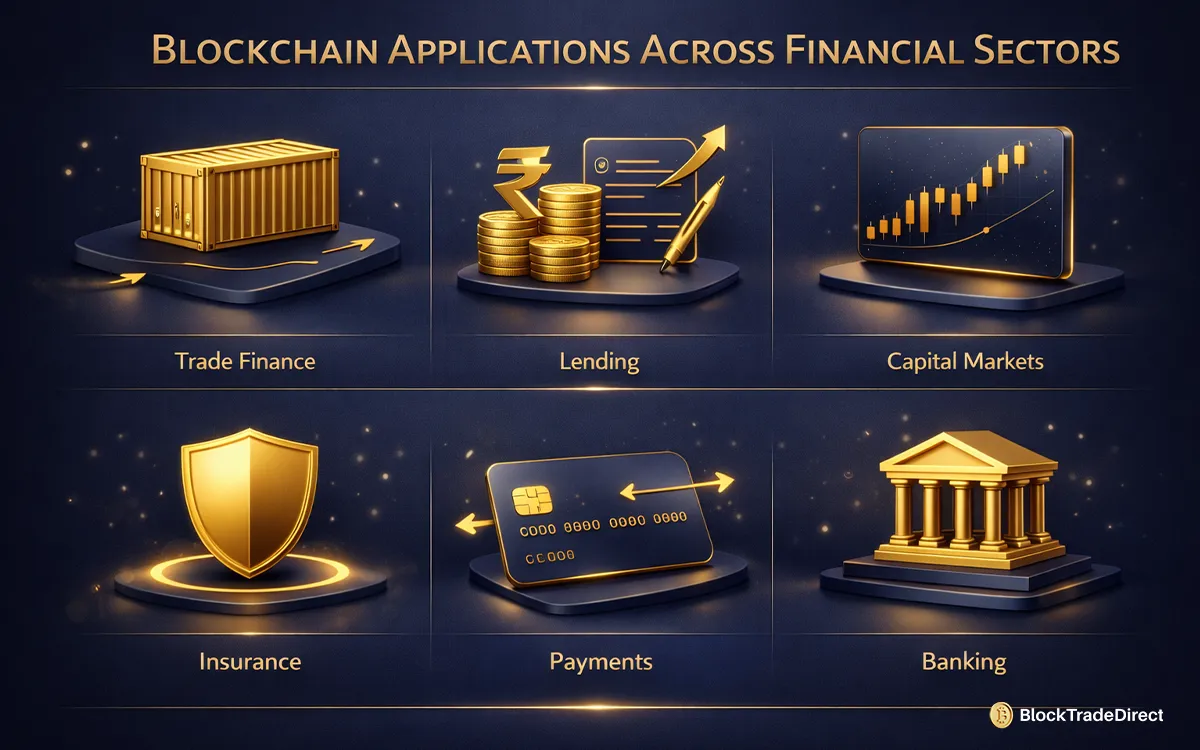
Blockchain adoption varies by sector, but the objective is consistent: reduce friction, increase transparency, and improve efficiency. What began with payments now spans banking, insurance, capital markets, and lending.
Key Blockchain Use Cases in Finance
|
Financial Sector |
Primary Use Case |
Practical Impact |
|
Banking |
Cross-border payments |
Faster settlement, lower costs |
|
Payments |
Stablecoins and digital currencies |
Near-instant transfers |
|
Insurance |
Smart contract claims |
Automated payouts, reduced fraud |
|
Capital Markets |
Tokenized securities |
Fractional ownership, liquidity |
|
Lending |
Decentralized lending platforms |
Broader access to credit |
|
Trade Finance |
Digital documentation |
Faster processing, fewer disputes |
Blockchain technology is being adopted for settlements and liquidity management by banks more and more. It is also being used by payment providers to transfer value internationally without resorting to complex correspondent banking chains.
With the help of blockchain, the automation of claims processing is made possible once certain conditions are met. The resulting benefits include lower administrative costs, quicker turnaround times, and higher accuracy.
Tokenization is redefining the asset issuance and trading process. The investors are gaining fractional access, and the issuers are acquiring faster settlement and easier compliance as their advantages.
Blockchain-enabled lending platforms facilitate direct interaction between borrowers and lenders, and digital assets are frequently used as collateral. This not only extends access but also rounds up various credit models with increased automation for testing.
The aforementioned applications demonstrate that blockchain is making a transition from a trial to an industrial-strength finance infrastructure.
A direct comparison between the operation of today's traditional financial systems and that of blockchain will help us understand the traction blockchain is acquiring. The distinction is not only technological but also very structural.
Centralized domination, intermediaries on different levels, and recordkeeping in disjointed manners are the main features that characterize traditional finance. Blockchain changes all that by introducing a common platform, automatic checking of transactions, and unifying the data.
Key Differences at a Glance
|
Aspect |
Traditional Finance |
Blockchain-Based Finance |
|
Control |
Centralized institutions |
Distributed networks |
|
Recordkeeping |
Separate internal ledgers |
Shared ledger |
|
Settlement Speed |
Hours to days |
Minutes or seconds |
|
Transparency |
Limited visibility |
Verifiable records |
|
Operational Costs |
Higher due to intermediaries |
Lower through automation |
|
Availability |
Business hours |
24/7 operation |
In classic approaches, the truth is one version only, and that version is the one each institution holds. Reconciliation occurs after the transaction has already been processed, resulting in delays, mistakes, and conflicts.
Blockchain changes this model to the opposite. Each transaction is verified, and then the whole network is updated at once. There are no more repeated checks between parties because all of them have access to the same trustworthy data.
This is a big step forward for the finance industry as a whole. Users get benefits in the form of faster and cheaper transactions, more transparent records, and the elimination of certain fees.
The comparison highlights the fact that while blockchain is not displacing finance overnight, it is slowly but surely becoming the core layer on which the new financial systems are constructed.
Besides the experimentation period, financial institutions have also set their minds on integrating blockchain-based solutions with their existing systems through efficient, regulated, and scalable implementations that will lead to compliance and efficiency, hence blockchain adoption in finance by early 2026.
Banks, asset managers, and payment networks are actively deploying blockchain for settlements, asset issuance, and internal reconciliation.
Stablecoins are increasingly used as digital cash equivalents rather than speculative assets.
Clearer regulatory frameworks have accelerated adoption.
Many central banks are piloting or deploying digital currencies influenced by blockchain architecture.
Blockchain is increasingly combined with automation to streamline operations.
The emphasis has shifted toward connecting networks and handling higher transaction volumes.
These trends show blockchain maturing into core financial infrastructure rather than a disruptive side technology.
Blockchain adoption in finance continues to grow, but several challenges slow large-scale deployment. Most are related to regulation, infrastructure transition, and usability rather than the technology itself.
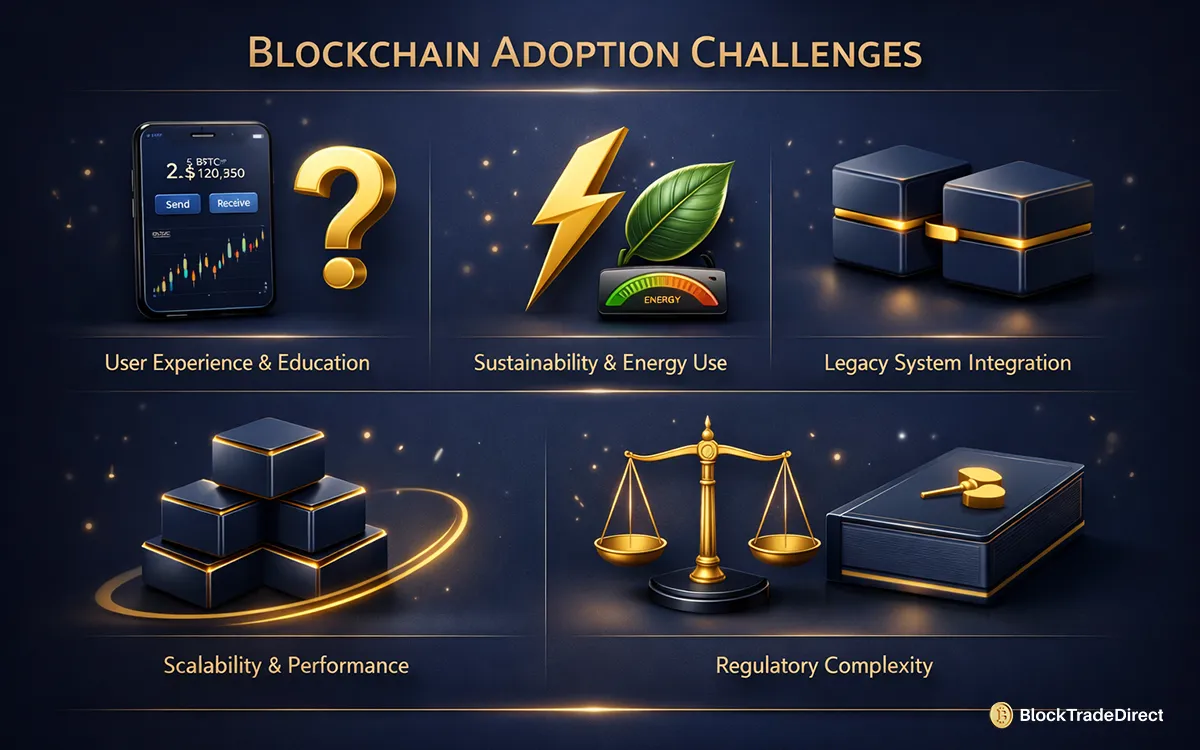
Financial regulations differ widely by region, and blockchain often crosses jurisdictions.
Some blockchain networks struggle with high transaction volumes.
Financial institutions rely on decades-old infrastructure.
Energy consumption remains a concern for certain networks.
Blockchain introduces new responsibilities for users.
These challenges shape how blockchain is implemented, encouraging more regulated, scalable, and user-friendly financial solutions.
Blockchain's presence in finance and its applications are not aiming to replace banks nor to do away with regulations. Rather, it is concerned with the renovation of the financial systems' infrastructural setup.
Gradually, blockchain is being integrated into backend operations instead of being made visible to the users. Payment transactions are done quickly, records of ownership get updated automatically, and the controls for compliance take place in real time. The technology becomes obscure, but its effect becomes the norm.
Key shifts already underway include:
As blockchain moves from innovation to infrastructure, success will depend on how effectively institutions integrate it into existing systems.
The financial industry blockchain has really moved from being a thing that is not commonly used or appreciated to being an already recognized and accepted thing in the industry. Its effects are already seen in the whole process of transferring money and settling, owning assets, and complying with regulations.
What is the reason blockchain is grabbing the attention is not one particular usage, but the overall transformation of trust, automation, and recording of documents that it brings. Blockchain as a financial system is gradually but certainly changing the direction of value movement around the world. It is a slow change, but it is fundamental and still in progress.
Blockchain in finance refers to using distributed ledger technology to record transactions, manage assets, and automate financial processes without relying on centralized intermediaries.
Blockchain enables faster settlement, lowers transaction costs, improves transparency, and reduces fraud through tamper-resistant records.
No. Blockchain is widely used for payments, banking settlements, lending, insurance claims, asset tokenization, and compliance reporting.
Banks use blockchain for cross-border payments, interbank settlements, trade finance, and secure data sharing to reduce costs and processing time.
Key challenges include regulatory uncertainty, scalability limits, integration with legacy systems, energy concerns, and user education.
No. Blockchain is becoming an infrastructure that financial institutions use to operate more efficiently and transparently, not a replacement for them.